

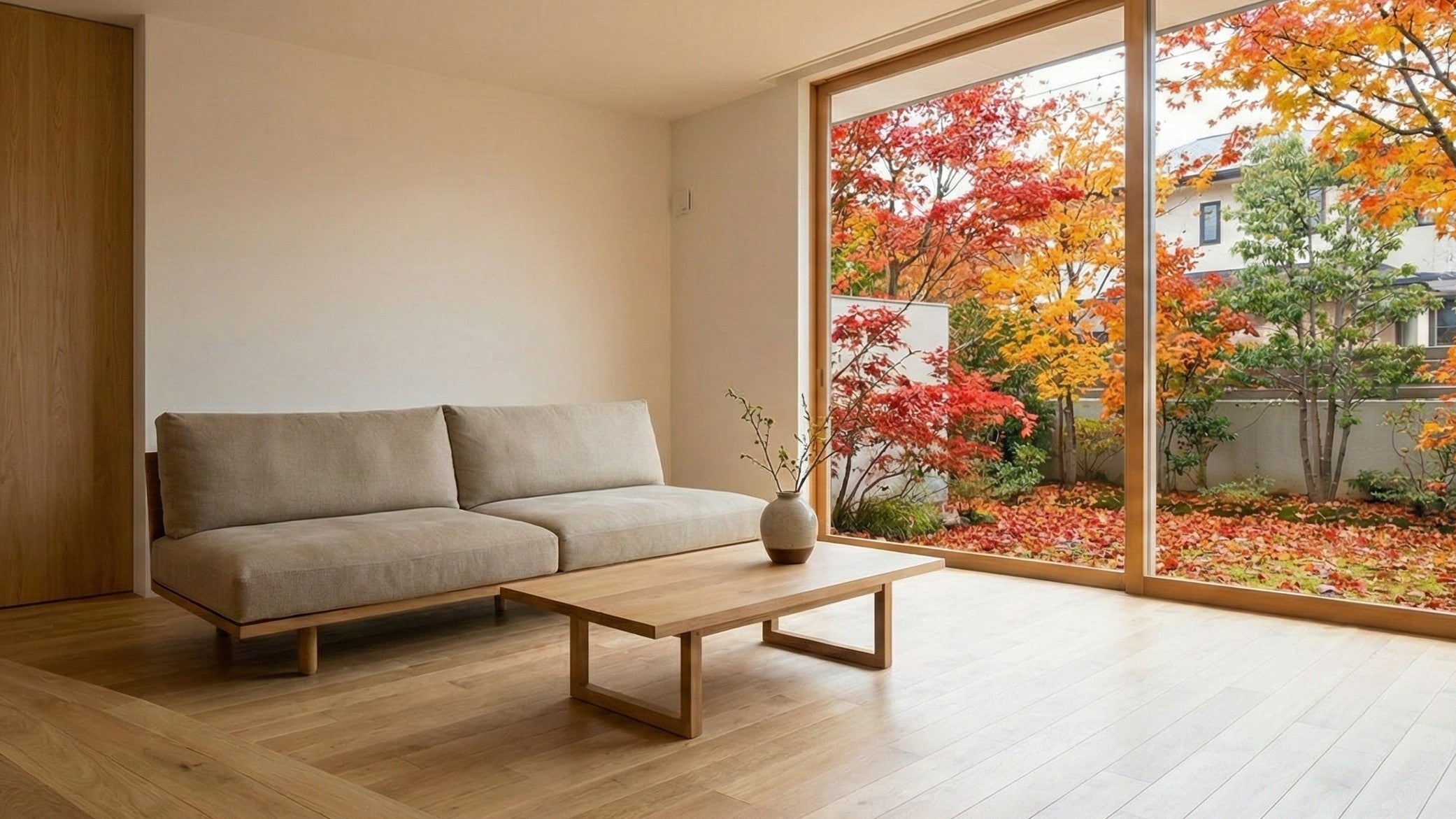
The Calm Aesthetic: Why Japanese Design Feels so peaceful
You open the door, and the world finally goes quiet.
No visual shouting, no noise from half-finished tasks, no clutter competing for your attention. Just space, light, and a steady sense of equilibrium.
Most of us do not realize how much our home can amplify stress until we step into a space that does the opposite. When the eye has too much to process, the mind never fully lands, even on a quiet evening.
In this article, you will learn the principles behind the Japanese calm aesthetic, the science linking clutter to stress, and practical ways to bring a softer, more restorative rhythm into your own home.
The 4 Pillars of Japanese Design: Ma, Wabi-sabi, Shibumi, and Kanso
Japanese calm is shaped by a small set of principles that work in harmony.
Each concept below offers a different path to peace: space for the mind, simplicity in daily life, imperfection that softens pressure, and refinement that stays quiet.
Ma: The Power of Negative Space in Interior Design
Perhaps the most profound concept in the Japanese “peace toolkit” is Ma (間).
Often translated as “void” or “emptiness”, Ma is really the pause that gives meaning to what remains. In music, it is the silence between notes.
At home, it is the intentional empty corner, the clear tabletop, the breathing room around a single object.
One of the most useful ways to understand Ma is as a “gesture of trust.”
The designer, or the homeowner, does not fill every inch. They leave space for the mind to settle, to wander, to recover.
That space is not wasted. It is restorative.
Wabi-sabi: the relief of the real
I like to think of Wabi-sabi (詫び寂び) as the antidote to a world of high-pressure perfection. This ancient philosophy values what is imperfect, impermanent, and incomplete, which is another way of saying: human.
A subtle asymmetry in a hand-thrown cup, a glaze that shifts into natural variation, a surface that will age instead of resisting time, these details do something quietly radical.
They ease the pressure of maintaining an impossible “showroom” standard, making room for a lived-in peace that feels earned, not manufactured.

Handcrafted chawan by master potter Kazuhiro Kojima of Nunobiki Pottery, a refined expression of wabi-sabi in Japanese ceramics.
Shibumi: The Sophistication of Restraint
Shibumi (渋み) is the Japanese aesthetic of "refined sobriety," a form of beauty that is direct and effortless without being flashy. It is the art of creating a profound presence through restraint, allowing an object to possess a quiet authority that gives a space its sense of grounded calm.
In the world of high-end design, we often see objects that "perform" by demanding your gaze with loud colors or intricate patterns. Shibumi is the exact opposite. It is a beauty so confident in its own skin that it has no need to shout.
When you place a shibui* object in your home, it does not try to dominate the room, instead, it rewards the observer who takes the time to look closer.
For the modern professional, this "discreet elegance" is the visual equivalent of a deep, calm breath in a world full of noise.
* In Japanese, Shibumi is the noun (the concept), while Shibui (渋い) is the adjective (the quality of the object).
Kanso: The Strategy of Purity
Kanso (簡素) is the Zen principle of "simplicity" achieved through the intentional elimination of clutter.
By removing the non-essential, this design strategy reveals the core essence of a space and effectively lowers cognitive load to sharpen mental focus.
If Ma represents the space itself, Kanso is the discipline used to protect it.
It is not about living in a vacuum; it is about the "elimination of cognitive friction" by removing the visual noise that competes for our subconscious attention.
Our brains are naturally wired to scan our surroundings, and every unnecessary trinket acts as a micro-distraction. Practicing Kanso is an act of psychological maintenance.
By choosing one soulful piece of craftsmanship over a dozen mass-produced distractions, you allow your mind to stop "scanning" and finally start resting.
It doesn't just clear your shelves: it clears your head.
The Science of Calm: How Minimalism Reduces Cortisol by 22%
Scientific research confirms that home environments directly shape stress biology, with studies showing that minimalist, organized spaces can reduce cortisol levels by up to 22%.
Clutter and visual noise act as "unfinished" cues that keep the nervous system in a state of high alert, while Japanese design principles help the brain transition from constant scanning to a restorative rest state.
The "peaceful feeling" we experience in a well-ordered room is more than a mood; it is a physiological response. When our living spaces are filled with competing materials, unfinished projects, and physical clutter, our brains treat those items like a silent to-do list.
This creates a state of chronic demand where the body never feels it has permission to fully stand down.

Why Your Brain "Scans" Clutter as a Threat
Cortisol is our primary stress hormone.
While it is essential for waking up and staying focused, the goal for a healthy home life is to avoid chronic elevation of stress.
A landmark study by Saxbe and Repetti (2010) found that individuals who described their homes as "cluttered" or full of "unfinished projects" exhibited less healthy daily cortisol patterns.
The home wasn't just messy; it was signaling an ongoing demand for attention.
This is where the Japanese concepts of Kanso and Ma move from the mystical to the practical.
By limiting materials and maintaining visual continuity, these designs reduce the number of "visual transitions" the brain has to track.
When the eye isn't forced into "scan mode" (jumping from one pile or color to the next) cognitive load drops.
You feel calmer because the room simply asks less of you.
The 22% Factor: Designing for Physiological Recovery
Recent findings, including a 2026 synthesis in the IJFMR by R. Jogdand and P. Patwari which compiled research from NM Agha et al. (2025), suggest that moving toward a minimalist, intentional environment can reduce cortisol levels by as much as 22%.
While this figure represents an optimal upper bound, the takeaway for the modern homeowner is clear: reducing visual overload is a form of biological maintenance.
By choosing fewer, higher-quality objects (like a single piece of artisanal pottery or handcrafted traditional manaita) you replace a dozen micro-distractions with one focal point of beauty.
You are essentially hacking your own biology, transforming your home from a source of stimulus into a sanctuary for physiological recovery.
Calm as a Daily Practice: How to Live the Japanese Calm Aesthetic
Japanese calm is not achieved by buying a “style.”
It is built through small habits, fewer objects, and a home that encourages transitions, from public to private, from busy to slow, from noise to presence.
Decluttering for the mind, not for the “look”
Most people declutter to make a room appear tidy. Japanese calm declutters to make the mind feel lighter.
A useful reframe is simple: keep what you truly use and value, remove what keeps pulling at your attention.
When a shelf is full, the eye never rests. When a tabletop is crowded, the brain keeps listing tasks.
Like we have said before, creating Ma, is not minimalism for aesthetics. It is breathing space you can feel.
And once you own fewer objects, quality stops being a luxury detail and becomes the point.
One well-made bowl you reach for every day can replace a cabinet of “fine” plates you never truly enjoy using.
Why Handcrafted Objects Bring More Peace Than Mass-Production
There is a layer of calm that many design guides miss: the emotional effect of human effort.
In Japanese craftsmanship, this feeling is especially tangible, and it can be summed up, in broad terms, through two closely related ideas.
-
Shokunin kishitsu (職人気質) is the craftsman’s spirit, the quiet discipline behind making something properly.
-
Kodawari (こだわり) is the insistence on quality, the refusal to rush what should not be rushed.
When you live with objects shaped by that mindset, you sense it.
The piece carries patience, and you respond with patience. It is a small feedback loop, but it is real.

Artisan hands at work, embodying shokunin kishitsu, the quiet Japanese discipline and devotion to making something with care, precision, and integrity.
Practical Steps to Create Your Own Japanese Sanctuary
So how do you bring Japanese calm into your home and create a more peaceful space?
First of all start small.
Reduce the visual noise, give one object room to breathe, and use soft light and honest materials, tactile ceramics to shift the mood of the room.
You can try to begin with one surface or space you see every day (an entry console for example, a dining table or sideboard) and build a three-object “calm corner”":
- One grounded object (clay, stoneware, wood).
- One soft-glow object (a washi lamp or warm side light).
- One “breathing” space left intentionally empty (This is Ma concept we have discussed early).
This sounds almost too simple, but that is the point. Calm is not created by adding. It is created by choosing, then stopping.
Then, buy less, but buy better.
A few well-made pieces, used daily, do more than shelves of extras.
They slow your gestures, soften the atmosphere, and make calm feel like something your home naturally holds.
Japanese Calm Aesthetic Q&A
Quick answers to the questions people ask when they want a calmer home, without turning life into a design project.
What is the single most effective Japanese principle for calm at home?
Ma (間, ma) is the fastest win. Leave one area intentionally empty, a tabletop, a shelf, a corner. That “pause” reduces visual noise and gives the mind a place to rest.
How does Wabi-sabi (詫び寂び, wabi-sabi) reduce stress?
Wabi-sabi replaces perfection with acceptance. Handmade, slightly imperfect objects feel human, and they quietly lower the pressure to maintain a showroom life.
What is Kanso (簡素, kanso) in practical terms?
Kanso is simplicity with purpose. Remove what does not serve daily life, then keep what supports your rituals. It is not “less for style,” it is “less for clarity.”
Is there evidence that clutter affects cortisol?
Yes. Saxbe and Repetti (2010) linked a more “stressful home” environment to less healthy daily cortisol patterns, suggesting home conditions can shape stress biology.
A more recent study is a A 2026 IJFMR paper reports a compiled finding (NM Agha et al., 2025) suggesting minimalist environments can reduce cortisol by up to 22%.
Treat it as supportive evidence, not a guaranteed outcome for everyone.
What are the key elements of a peaceful Japanese interior design?
A peaceful Japanese interior relies on Ma (間, “the space between”), Kanso (簡素, “simplicity”), Wabi-sabi (詫び寂び, beauty in the imperfect), and Shibumi (渋み, quiet refinement).
Together they reduce visual noise, favor honest materials, and create a space where the mind can rest.
How can you incorporate peaceful Japanese design into a small apartment?
In small spaces, aim for “pockets of stillness.”
Keep one surface mostly clear to practice Ma (間), reduce visual clutter with Kanso (簡素), and use soft, diffused light.
Choose 1–2 natural-material pieces you use daily, and leave one corner intentionally open as a visual reset.


