

The Owl as a Lucky Charm in Japanese Culture: Symbolism, History, and Ceramics
The Fukuro (梟, owl) is one of Japan's most beloved lucky animals. Behind every ceramic figurine, every mug decorated with its unmistakable round gaze, lies a history spanning thousands of years: from prehistoric animism and medieval theatre to smallpox remedies and sophisticated wordplay.
- Fukuro (梟): More Than a Lucky Charm: A Layered History
- The Owl in Disgrace: The Medieval Period
- The Great Rehabilitation: How the Owl Became a Lucky Charm
- The Owl in Japanese Art: From Netsuke to Ukiyo-e Prints
- The Owl in Japanese Ceramics: Techniques, Traditions, Kilns
- What Makes a Japanese Ceramic Owl Special
- Japanese Owl Ceramics: Frequently Asked Questions
This guide explores the owl's evolution in Japanese culture and its deep connection to the ceramic tradition, from ancient kilns to contemporary workshops.
Fukuro (梟): More Than a Lucky Charm: A Layered History
Many people think of the Japanese owl as a simple good-luck symbol, a cute ornament for a shelf. The reality is far more fascinating.
The Fukuro (梟, owl) is a symbol that has undergone radical transformations across centuries: from guardian of the fields to nocturnal demon, from ill omen to talisman against hardship.
Understanding this history doesn't just deepen appreciation for a decorative object; it puts you in genuine contact with something authentic in Japanese culture.

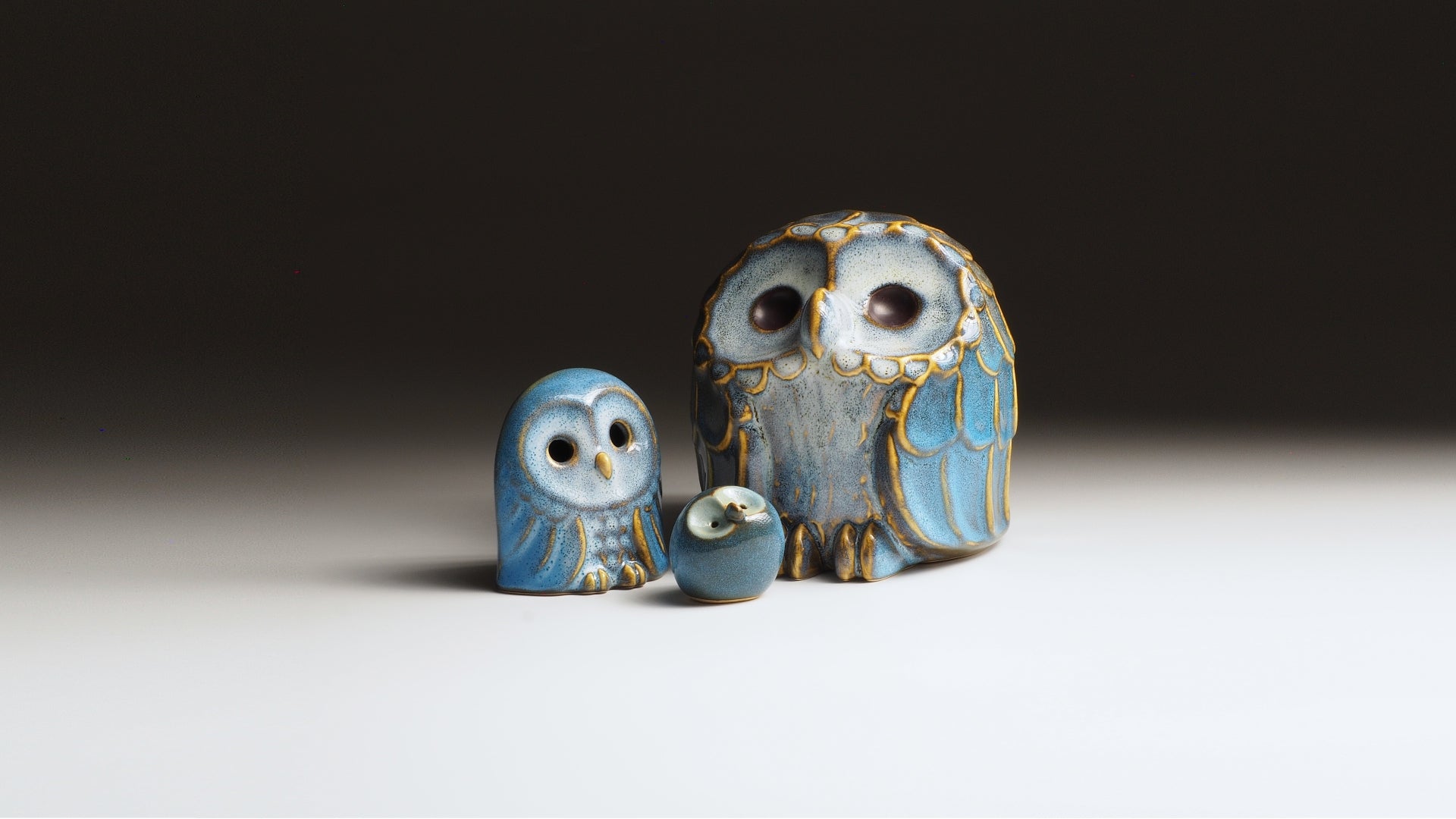
Sōfuku Owl figurines set by artist Kazuhiro Kojima, featuring the Nanasai Tenmoku glazing technique.
Prehistoric Origins: The Owl in Jōmon Art
The story of the owl in Japan begins long before written records. During the Jōmon period (縄文時代, Jōmon Jidai, c. 14,000–300 BCE), communities in central Japan maintained a deeply animistic relationship with the natural world, and the owl held a prominent place in their cosmology.
In the Yamanashi and Nagano regions, the Katsusaka-style pottery tradition developed a recurring decorative motif on ceramic vessels: the Sōkan-mon (双環文, double-ring pattern).
Some archaeological analyses interpret these linked concentric rings as a highly stylised abstraction of owl eyes. The owls' role as nocturnal predators of field mice (which threatened food stores), made them revered guardians of the harvest, and depicting them on storage vessels functioned as an apotropaic prayer.
The Jōmon communities also drew a symbolic parallel between owl nesting habits, raising young inside dark tree hollows, and human pregnancy. The Sōkan-mon appears frequently on female clay figurines (Dogu, 土偶) and on vessels associated with childbirth.
The Ainu World: Kotan-kor-kamuy
In northern Japan, the indigenous Ainu people of Hokkaido developed one of the most articulated relationships with the owl of any culture in the world, built on a strict species-based dualism.
The massive Blakiston's fish owl (島梟, shima fukuro) was worshipped as Kotan-kor-kamuy "the god who defends the village"*. In Ainu cosmology, this enormous nocturnal raptor acted as a mediator between the human and spirit worlds, protecting communities from famine, plague, and malevolent presences.
Conversely, certain smaller owl species were regarded as demonic beings (Wen-kamuy, malevolent spirits) capable of judging human moral character: said to close their eyes before a person of bad disposition (Ainu eshpa, "ignoring the man") and stare wide-open before someone of good character (Ainu oro wande, "searching out the man").
This dualism (the same animal as both village protector and moral arbiter-demon, depending on species) reveals a conceptual sophistication that goes well beyond any simple "lucky charm" label.
* the name kotankorkamuy is also the name used in Ainu language to indicate the owl.
The Owl in Disgrace: The Medieval Period
If you assumed the owl was always a good-luck symbol in Japan, the medieval record will surprise you.
With the arrival of Confucian and Buddhist texts from China during the classical and medieval periods, the owl was rebranded as the "unfilial bird" (不孝鳥, fukōdori). The source has its root in Chinese folk myth holding that the owl grew by devouring its own mother.
This association with matricide made it a symbol of moral corruption and social disorder. The Buddhist monk Nichiren (1222–1282) cited the myth in his theological treatise Kaimokushō (開目抄) to illustrate how even nature itself could behave in morally monstrous ways.
Kyōgen Theatre: The Comedy of Contagion
The owl's spiritual ambiguity found one of its most memorable expressions in Kyōgen (狂言), the traditional comic theatre performed alongside Noh.
The classic play Fukurō Yamabushi (梟山伏, "The Owl Mountain Priest") is a comedy about the impossibility of controlling nature through ritual.
The plot: a younger brother returns from the mountains afflicted by a strange ailment: he hoots like an owl and flaps his arms like wings, because he accidentally destroyed an owl's nest during his journey.
His older brother summons a Yamabushi (山伏, mountain ascetic priest) to perform an exorcism. Instead of curing the boy, the priest's esoteric prayers spread the "owl infection": first the older brother, then the priest himself begin to hoot and flap. The play ends with all three running offstage in unison.
It is a comedy, but also something more: a warning that nature cannot be controlled by human ritual, and that disrupting it carries contagious consequences.
The Great Rehabilitation: How the Owl Became a Lucky Charm
The most dramatic reversal in the owl's Japanese history takes place in the mid-to-late Edo period (江戸時代), and its roots are surprisingly concrete: smallpox.
The Aka-Mimizuku: Smallpox Talismans
Hōsō (疱瘡, smallpox) was one of the most feared diseases of pre-modern Japan, causing devastating child mortality and leaving survivors with severe facial scarring or blindness.
In the absence of effective treatment, families turned to sympathetic magic and the ritual pacification of the Hōsōgami (疱瘡神, Smallpox Deity). Folk medicine held that the colour red was exceptionally powerful, believed to please the deity and ensure pustules remained light and mild rather than turning black and fatal.
Sick children were dressed in red garments, and their rooms filled with Aka-mono (赤物, "red things"): folk toys painted with vivid red pigments, beautifully documented in historical woodblock collections like the Omocha Chigusa (おもちや千種) preserved by the National Diet Library. Among these objects, one figure emerged as central: the Red Horned Owl, or Aka-mimizuku (赤みみずく), below:

Kyōsen (Illus.), Omocha Chigusa, Vol. 9, [Kyōsen], 1922. National Diet Library Digital Collections.
The owl was chosen for several overlapping reasons.
Its large, unblinking, luminous eyes were believed to absorb the disease's heat and protect the child's vision.
Its long ear-tufts (羽角, hanikaku) resembled rabbit ears, carrying the associated symbolism of bounding back from illness.
And its physical form completed the picture: many Aka-mimizuku were made from papier-mâché (Hariko, 張り子) or clay, with a rounded, weighted base identical to a Daruma doll — when knocked over, they immediately returned upright.
This resilience was a direct metaphor for recovery, the hope that no matter how low the fever brought the child, they would rise again. The hollow construction of the papier-mâché body carried its own meaning too: being empty inside suggested the disease itself would remain insubstantial, passing through without taking hold.
As the immediate threat of smallpox receded, the Aka-mimizuku shed its identity as an emergency medical charm and settled into a broader role as an Engimono (縁起物, good-luck object) — a symbol of childhood health, resilience, and protection from misfortune in general
The Power of Wordplay: Goroawase
Alongside the medical talisman, a second mechanism drove the owl's fortification as a lucky symbol: Goroawase (語呂合わせ, phonetic wordplay), one of the most deeply embedded cultural practices in the Japanese language.
Japanese is rich in homophones, and the three syllables of Fukuro (フクロウ) can be written with different kanji, each yielding a distinct auspicious meaning:
- 不苦労 (Fukurō): "No hardship": the owl as a shield against life's difficulties.
- 福来郎 (Fukurō): "Fortune comes": the owl as an active attractor of prosperity.
- 福籠 (Fukurō): "Fortune is gathered in a basket": the owl as custodian of household wealth.
- 福老 (Fukurō): "Growing old in happiness": the owl as a wish for longevity, making it an ideal gift for the elderly.
There is also a biological association. In Japanese commercial slang, being overwhelmed by debt is expressed as Kubi ga mawaranai (首が回らない, "the neck cannot turn").
The owl, which can rotate its head nearly 270 degrees, becomes a financial charm: keeping one in the home ensures your business neck remains free, solvent and mobile.
The Owl in Japanese Art: From Netsuke to Ukiyo-e Prints
While the owl's talismanic role grew, its presence in elite art consolidated in parallel, often with a completely different aesthetic register.
Hiroshige and the Owl in Japanese Art
The great print master Utagawa Hiroshige (1797–1858), celebrated primarily for his landscapes, was also a prolific interpreter of Kachō-ga (花鳥画, bird-and-flower painting), producing roughly 1,000 compositions in the genre.
Among his most celebrated bird subjects is an owl perched on a pine branch beneath a crescent moon, paired with a poem by the poet Hachijintei describing the owl listening to the wind moving through the pines as if it were music.
What strikes the viewer in this print is not any explicit lucky symbolism, but its atmospheric quality: Hiroshige's owl is embedded in a seasonal environment (the nocturnal pine, the icy moon, winter silence) that transforms it into a poetic evocation of passing time rather than a talisman.
This print, along with other highlights from Hiroshige's career, is featured in the British Museum's guide to his work , a useful reference for anyone interested in how the owl appears in the wider context of Japanese art, distinct from the sculptural and ceramic traditions explored later in this article.
Netsuke: The Portable Sculpture
During the Edo period, Japanese men wore kimono with no pockets and carried personal items (medicine, tobacco, seals) in small pouches (Inrō, 印籠) suspended from the sash (Obi, 帯) by a carved toggle: the Netsuke (根付).
The owl was among the most beloved netsuke subjects. The reasons are both symbolic (its lucky charm associations) and purely sculptural: the large head, compact body, layered plumage, and expressive frontal gaze made it ideally suited to three-dimensional miniature form.

Owl shaped wooden Netsuke - Edo (1615–1868) or Meiji period (1868–1912). The Met Museum.
Carvers worked primarily in boxwood (Tsuge, 黄楊), ivory, or boar tusk, rendering the owl as a rounded, tactile form, often perched on a pine branch or nestled in a tree hollow. To capture the animal's intense gaze at miniature scale, master carvers inlaid the eyes with dark horn, amber, or black glass beads, a striking contrast against pale wood or ivory grain.
The Metropolitan Museum of Art in New York holds several outstanding examples, including an 18th–19th-century ivory netsuke of an owl with two owlets, and a wood netsuke of an owl on a branch with glass inlaid eyes. These objects entered the collection as early as 1910, as a gift of Mrs. Russell Sage, testimony to how swiftly the Japanese owl had captured Western collectors' imagination.
The Owl in Japanese Ceramics: Techniques, Traditions, Kilns
It is in ceramics that the owl perhaps finds its richest and most varied material expression. Japanese ceramic traditions have interpreted the owl in profoundly different ways depending on region, technique, and aesthetic, from the rustic wood-fired kilns of Shiga to the opulent porcelain ateliers of Ishikawa.
What follows focuses on the three traditions most closely associated with the owl as a living craft subject today, with a brief nod to the historical precedents that came before them.
Historical Roots: Oribe and Ko-Kutani
The owl's presence in Japanese ceramics has documented roots going back to the seventeenth century.
The Nomura Museum in Kyoto preserves an Oribe-ware (織部焼) owl incense container from that period, a sculptural tea-ceremony object covered in the tradition's characteristic green glaze, with the unglazed base revealing the warm red-orange of Hi-tsuchi (火色, fire colour).
Around the same time, the Museum of Oriental Ceramics in Osaka featured, in a 2021 temporary exhibition, a Ko-Kutani (古九谷焼) lobed dish painted with a horned owl in overglaze enamels—a motif the museum itself describes as rare in ceramics of the period, likely drawn from Chinese pictorial models.
These two objects define the two poles the owl occupies in Japanese ceramics from the start: three-dimensional sculptural form on one hand, painted surface image on the other. Every kiln tradition that followed has worked within some version of that same tension.
Kutani: Feathers Sculpted in Gold
Kutani ware (九谷焼, Kutani-yaki), from Ishikawa Prefecture, represents one of the most technically ambitious expressions of the owl in Japanese ceramics. Its signature palette — the Gosai (五彩, five colours) system of deep overglaze enamels combining green, yellow, red, purple, and Prussian blue — gives Kutani owls an immediate visual intensity that sets them apart from every other tradition.

Kutani ceramic owl figurine
The technique most closely associated with Kutani owl figurines is Deko-mori (デコ盛, raised relief enamelling). Artisans use a fine-tipped squeeze tool called an Itchin (一珍) to pipe a thick paste directly onto the fired porcelain surface, building up raised three-dimensional lines that physically sculpt the bird's layered chest feathers, the geometric swirl of its wings, the precise arc of each brow.
Once dry, these raised lines are filled with translucent colour glazes and, in many pieces, finished with liquid gold.
The result is an object that rewards handling as much as looking. Running a finger across a Kutani owl, you feel each feather individually, a ridge of glass and gold that catches the light differently at every angle. It is a level of tactile detail that no photograph fully captures, which is why owning one changes how you understand the piece entirely.
Shigaraki: The Owl of Earth and Fire
Shigaraki (信楽焼, Shigaraki-yaki), in Shiga Prefecture, is one of Japan's Six Ancient Kilns (Nihon Rokkoyō, 日本六古窯), and its approach to the owl could not be further from Kutani's precision. Where Kutani is controlled and jewel-like, Shigaraki is grounded in earth and fire.
The local clay (coarse, sandy, rich in feldspar) is the foundation of a tradition that has produced everything from ancient storage jars to tea vessels to the beloved Tanuki (狸, raccoon dog) figurines that have made Shigaraki a household name across Japan. It is in this same folk-craft spirit that the Shigaraki owl exists today.
Contemporary Shigaraki owls are built for versatility. Most are wheel-thrown or mould-cast and finished with partial glazes, typically in soft earthy tones, warm browns, creamy whites, or the occasional splash of colour, leaving enough of the natural clay body visible to keep that connection to the earth that defines the tradition.
They work equally well outdoors on a garden wall or front step, and indoors on a shelf or entranceway, where their rounded, compact forms (wide-eyed, slightly solemn, always a little endearing) bring the same quietly protective presence that has made Shigaraki folk ceramics so enduring.

Owl figurines displayed outdoors in Shigaraki, Shiga Prefecture, Japan.
While many pieces are designed with everyday accessibility in mind, the tradition also produces smaller, more refined works where the relationship between clay, glaze, and kiln atmosphere results in something genuinely singular: a reminder that in Shigaraki, the line between craft object and work of art has always been deliberately blurred.
This accessibility is precisely their appeal. A Shigaraki owl is not asking to be studied. It is asking to be lived with.
Nunobiki-yaki: The Owl as Origin Story
Of all the traditions covered here, Nunobiki-yaki (布引焼) has perhaps the most direct relationship between the owl as a ceramic subject and the owl as a living presence.
When Taro Kojima established his workshop in Higashiōmi, Shiga Prefecture, in the early 1970s, a dense forest bordered the land. An owl lived there, appearing at dusk, perched and still, as if keeping watch over the kiln below.
There was something in that presence Kojima couldn't ignore. He sat down with clay and shaped what he saw: an owl, quiet and steady, the way the real one had always been. That first figure became the founding motif of an entire ceramic tradition.

Fukumori Owl figurine by artist Kazuhiro Kojima, featuring the Nanasai Tenmoku glazing technique.
The studio developed a distinctive glazing technique called Nanasai Tenmoku (七彩天目, Seven-Colour Tenmoku), which allows multiple glazes to be applied to a single piece and fired together, bleeding into one another in transitions that resemble watercolour more than conventional ceramic glazing.
Deep forest greens shift into warm amber, soft pinks dissolve into grey-blue — the colours of a woodland at different hours and seasons.

Fukuro teacup by Kazuhito Kojima of Nunobiki Kiln, adorned with a charming owl motif.
A Nunobiki owl does not look decorated. It looks inhabited.
The glaze doesn't sit on top of the form; it moves across it the way light moves through leaves, and the result is a piece that changes character depending on where you stand and how the light falls.
For anyone drawn to the owl as a creature of atmosphere rather than ornament, it is hard to find a ceramic tradition that captures that quality more precisely.
What Makes a Japanese Ceramic Owl Special
A Japanese ceramic owl is special because it is not simply decorative. It carries a wish of luck and fortune.
The Fukuro has travelled a long road: from prehistoric harvest guardian to medieval ill omen, from smallpox talisman to contemporary ceramic art.
That the same animal could carry such contradictory meanings across centuries, and still arrive at a symbol of protection and good fortune, is part of what makes it so compelling.
A Gift That Says Something
A Japanese ceramic owl is one of the rare gifts that carries meaning without requiring explanation. The moment you place one in someone's hands, you are doing something specific: you are wishing them “不苦労”, no hardship. Not luck in the abstract, but the concrete, human hope that the person in front of you will be spared difficulty.
That is what separates a ceramic owl from a decorative object.
The craftsmanship, whether the organic warmth of Shigaraki clay or the Nanasai Tenmoku coloured glaze of Nunobiki , gives the gift its beauty. But the symbolism gives it its weight.
The person receiving it knows, even instinctively, that something intentional was chosen for them. That someone thought: I want this person to be well.
Few objects manage that so quietly.
Japanese Owl Ceramics: Frequently Asked Questions
Quick answers to the most common questions about owl symbolism, ceramic traditions, and what to look for when choosing a Japanese owl figurine.
What does a Japanese owl figurine mean as a gift?
It carries the wish of 不苦労 (Fukuro): no hardship, no suffering. Suitable for new homes, new jobs, graduations, or anyone navigating a difficult period. One of the most meaningful and versatile good-luck gifts in Japanese culture.
Is a ceramic owl an appropriate gift for any occasion?
Yes. Because the symbolism centres on protection and resilience rather than a specific event, a Japanese owl works across a wide range of occasions: housewarmings, birthdays, farewells, recovery from illness, or simply as a meaningful everyday gift with genuine cultural depth.
Do Japanese owl figurines need to face a specific direction to bring good luck?
No fixed rule exists, but many people place their owl near the entrance of a home or workspace, where it can "watch over" what comes and goes. The most important thing is that it feels intentional: a Japanese ceramic owl works best when it is placed somewhere you actually see it every day.
What makes Shigaraki owl figurines distinctive?
Coarse local clay, wood-fired kilns, and natural ash deposits give each piece an organic, unrepeatable surface. Robust enough for outdoor display. Equally at home on a garden step or an indoor shelf.
What is Nunobiki-yaki and why is it associated with owls?
A contemporary studio tradition from Shiga Prefecture, founded next to a forest where wild owls nest. Its Nanasai Tenmoku (七彩天目) glazing technique layers multiple metallic glazes that shift colour with the light. The owl is the central motif of the entire tradition.
Where does Japan's lucky owl tradition come from?
Three overlapping sources: the owl's role as a predator of crop-destroying field mice, its use as a protective talisman during Edo-period smallpox epidemics (the red Aka-mimizuku), and the linguistic wordplay that rewrites Fukuro as 不苦労, "no hardship." The modern lucky owl is the product of all three.
%20is%20one%20of%20Japan's%20most%20beloved%20lucky%20animals.%20Behind%20every%20ceramic%20figurine,%20every%20mug%20decorated%20with%20its%20unmistakable%20round%20gaze,%20lies%20a%20history%20spanning%20thousands%20of%20years:%20fr...)