
Can Japanese Pottery Go in the Dishwasher or Microwave?
Some Japanese pottery can be used in a microwave, dishwasher, or both, while other pieces should not. Dense, high-fired stoneware and porcelain are often more compatible with these appliances, but the material alone is never a guarantee. Earthenware generally requires greater caution. Pottery with metallic decoration must never be microwaved and should normally be washed by hand. Kintsugi-repaired pieces should also be kept out of both appliances.
- Japanese Pottery: Dishwasher and Microwave Safety at a Glance
- What Determines Whether Japanese Pottery Is Dishwasher- or Microwave-Safe
- Using Handmade Japanese Pottery in a Dishwasher
- Using Handmade Japanese Pottery in a Microwave
- Earthenware, Stoneware, and Porcelain Compared
- Can Kannyū or Crackle-Glazed Pottery Go in the Dishwasher or Microwave?
- Direct Guidance from the Japanese Makers We Work With
- Japanese Pottery Dishwasher and Microwave FAQs
Japanese pottery is not a standardized material. Compatibility depends on the clay body, firing, water absorption, glaze, form, construction, and intended use. Two pieces that look equally sturdy may respond differently to heat, detergent, water pressure, and repeated temperature changes.
This guide explains what makes Japanese pottery microwave- or dishwasher-safe and when hand washing is the better choice.
Japanese Pottery: Dishwasher and Microwave Safety at a Glance
Use this quick reference to see when Japanese pottery may be suitable for a microwave or dishwasher, and when hand washing is the safer choice.
| Situation | Microwave | Dishwasher | Safest response |
|---|---|---|---|
| The individual product is explicitly approved | Yes | Yes | Follow the product-specific instructions. |
| The maker advises against the appliance | No | No | Hand wash and use another vessel for reheating. |
| No care instructions are available | Do not assume | Do not assume | Hand wash and avoid microwave use until confirmed. |
| The piece is approved but rare or difficult to replace | If approved | If approved | Hand washing remains the gentler option. |
| The piece is chipped or structurally cracked | Do not use | Do not use | Stop appliance use until the piece has been assessed. |
Swipe horizontally to view the complete table.
What Determines Whether Japanese Pottery Is Dishwasher- or Microwave-Safe
Japanese pottery includes many clay bodies, firing methods, glazes, and regional practices. The word pottery may refer to relatively porous earthenware, dense stoneware, or, in everyday English, Japanese ceramics more broadly.
Two cups can appear equally sturdy while behaving very differently when exposed to heat, water pressure, detergent, and repeated temperature changes.
Clay Body, Firing, and Water Absorption
As clay is fired, its particles bond and the body generally becomes denser. Higher firing temperatures can reduce open porosity and water absorption, but temperature alone does not provide a complete answer.
Clay composition, firing atmosphere, time at peak temperature, glaze coverage, and the maker’s process all affect the finished piece.
A vessel described as high-fired may be durable, yet it should still not be treated as microwave- or dishwasher-safe unless the maker has approved that use.
Glaze, Unglazed Surfaces
A glaze can make a surface less absorbent, but glaze type, fit, and coverage vary. Unglazed areas may behave differently from the glazed surface, so the appearance of a piece alone cannot confirm appliance compatibility.
Intentional crackle glazes require separate consideration and are discussed in the section on kannyū below.

Yunomi teacups from Usurai Pottery featuring the kannyu glaze technique with intricate crystallization on every cup.
Form and Thickness
A thick bowl, a thin-rimmed teacup, a handled mug, and a cup-and-saucer set do not face the same risks. In a dishwasher, fine rims and projecting handles are more vulnerable to contact and vibration.
In a microwave, an uneven or very thick form may heat differently from a thin, regular one. The intended use of the object matters as much as the broad material category.
Why the Maker’s Instructions Come First
The maker knows the clay recipe, firing schedule, glaze, surface treatment, and intended use. A retailer working directly with the maker can also provide product-specific guidance. This is more reliable than judging from color, weight, surface texture, or a general label such as stoneware.
For every Tsukushi purchase, the Care Guide on the individual product page should be treated as the primary reference.
Using Handmade Japanese Pottery in a Dishwasher
Dishwasher-safe means that a piece is considered compatible with machine washing, not that it is immune to wear. The main risks are movement and contact inside the machine, particularly for fine rims, handles, lids, and saucers. Detergent, pressurized water, heat, and repeated drying cycles may also affect certain glazes, unglazed surfaces, or fine details over time.
Dishwashers also vary considerably by model and country. Some machines sold outside Japan may use longer cycles, stronger water jets, or higher drying temperatures than those considered by a Japanese maker when providing general care advice. Nunobiki Pottery has specifically cautioned Tsukushi against applying one dishwasher rule across different products and markets. When the machine settings or product instructions are unclear, hand washing is the safer option.
Even when dishwasher use is permitted, hand washing remains the gentler choice for rare, made-to-order, one-of-a-kind, or difficult-to-replace pieces. Functional Japanese pottery is made to be used, but careful handling helps preserve the individual qualities that made the piece worth choosing.
How to Load Dishwasher-Approved Pottery Safely
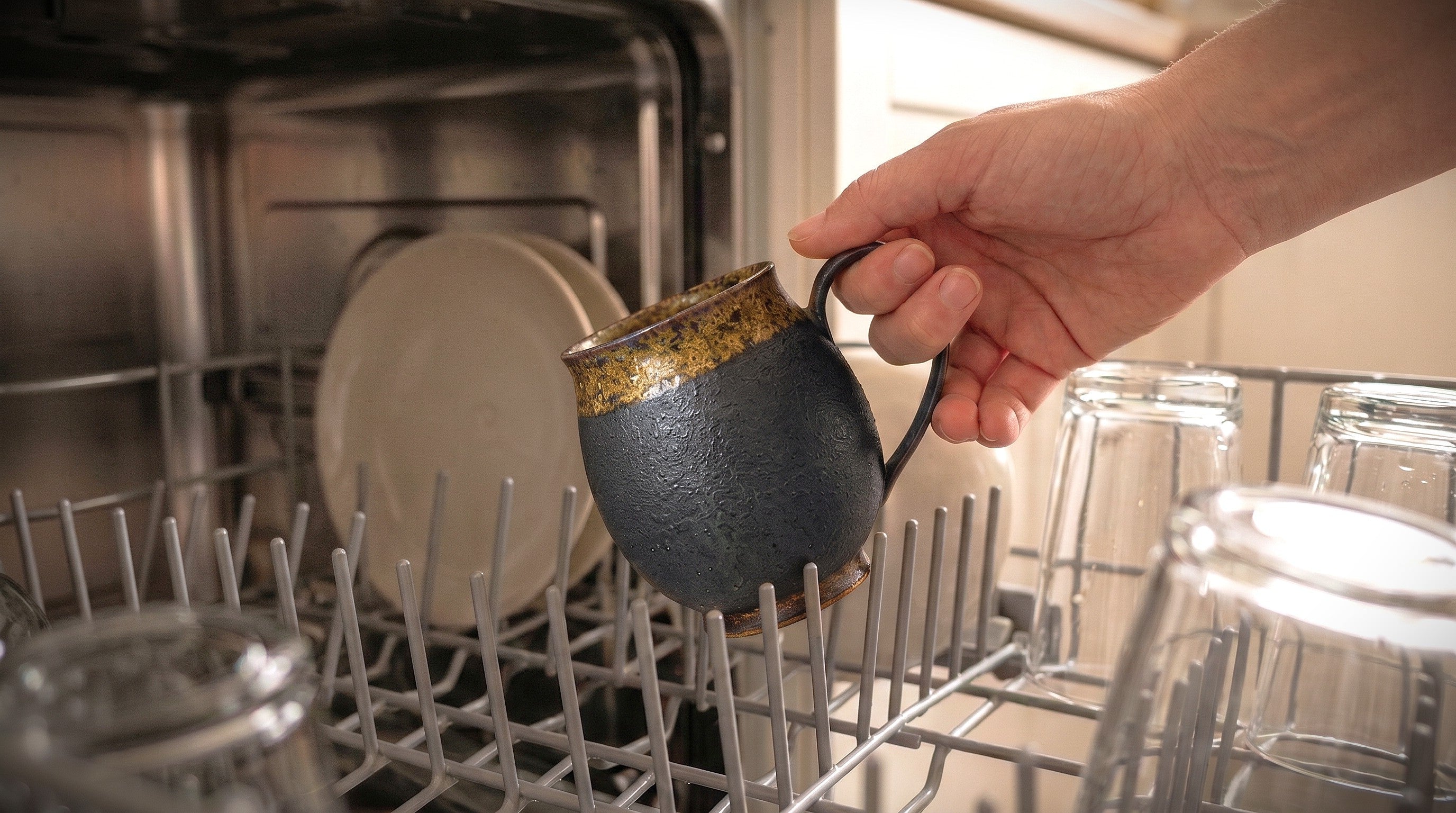
When dishwasher use is explicitly approved, follow these precautions:
- Place each piece securely so it cannot rock, slide, or turn.
- Keep cups, bowls, saucers, and lids from touching other tableware.
- Position fine rims and handles away from the metal rack and heavy utensils.
- Do not stack components or place a cup directly against its saucer.
- Use the gentlest suitable cycle available.
- Remove and dry the piece thoroughly, especially when it has kannyū or unglazed areas.

Important: A gentle cycle cannot make an unapproved piece safe. These precautions apply only to pottery that has been confirmed as dishwasher-compatible.
Using Handmade Japanese Pottery in a Microwave
Some handmade Japanese pottery is microwave-safe, but appearance alone cannot confirm compatibility. A ceramic vessel may become hot as heat transfers from the food or drink, while water absorption, glaze composition, thickness, and uneven heating can also affect how it responds. A warm bowl is not necessarily defective, but stop using it if it becomes unusually hot compared with its contents or develops a new smell, sound, line, or visible change.
Microwave-safe pottery is not immune to thermal shock. Avoid heating a very cold piece, pouring boiling liquid into a cold vessel, or placing hot pottery on a cold or wet surface. Sudden temperature changes can create stress within the ceramic body or glaze.
Do not test valuable, one-of-a-kind, or difficult-to-replace pottery when microwave compatibility has not been confirmed. A successful household test does not guarantee safe repeated use. In that situation, reheat food in a vessel that is explicitly microwave-safe.

Handcrafted matcha bowl from Nunobiki Pottery—not recommended for microwave use.
Earthenware, Stoneware, and Porcelain Compared
Material categories help explain general tendencies. Porcelain is included here only as a useful comparison within the broader category of Japanese ceramics.
| Category | General tendency | What it may suggest | What it cannot prove |
|---|---|---|---|
| Earthenware | Often fired at lower temperatures and generally more absorbent. | Greater caution with microwave and dishwasher use may be sensible. | It does not prove that every earthenware piece is unsuitable for either appliance. |
| Stoneware | Usually denser and fired at higher temperatures than earthenware. | It may tolerate frequent daily use and have relatively low water absorption. | It does not prove that all stoneware is microwave- or dishwasher-safe. |
| Porcelain | Generally dense, highly vitrified, and low in water absorption. | Many undecorated porcelain pieces are practical for appliance use. | It does not prove that every porcelain object is safe regardless of its finish, form, or maker’s instructions. |
Material categories provide useful context, but they do not replace the instructions for the individual piece.
To learn more about the differences between pottery and porcelain, read our dedicated article here: Japanese Pottery vs. Porcelain
Can Kannyū or Crackle-Glazed Pottery Go in the Dishwasher or Microwave?
Kannyū (貫入) is a deliberate crackle pattern within the glaze. It is valued in Japanese ceramics for the depth and individuality it gives the surface. It should not be confused with a structural crack running through the clay body.
Crackle glaze does not create one universal appliance rule.
Usurai Pottery provides a useful real-world example: the current Usurai pieces selected by Tsukushi are approved for microwave and dishwasher use despite their visible kannyū.
The maker nevertheless recommends careful handling, avoiding contact in the dishwasher, drying the pottery well, and considering medome (目止め) to reduce the penetration of stains and odors over time.
If a fine line changes suddenly, extends into the body, leaks, or is accompanied by a chip or impact, treat it as possible damage rather than ordinary kannyū and stop using the appliance until the piece has been assessed.
Direct Guidance from the Japanese Makers We Work With
The guidance below applies to the pieces currently selected by Tsukushi and is based on information received directly from the makers. It should not automatically be extended to every past or future piece produced by the same pottery.
Usurai Pottery, Kyoto
The current Usurai Pottery tableware carried by Tsukushi is approved for both microwave and dishwasher use. In a dishwasher, pieces should be positioned so that rims, cups, and saucers cannot touch or rattle against other items.
Hand washing remains the gentler option. The maker also recommends medome for customers who want additional protection against stains and odors developing within the kannyū surface over time.
Ohmi Ceramics, Kusatsu
The Ohmi Ceramics tableware currently carried by Tsukushi is approved for microwave and dishwasher use. These pieces are high-fired and described by the maker as having low water absorption.
Their unglazed surfaces are still handmade, so cups, bowls, lids, and saucers should be loaded separately, kept away from contact, and dried thoroughly after washing.

Textured surface detail of an unglazed espresso cup by Ohmi Ceramics.
Nunobiki Pottery, Shiga
Nunobiki instructions vary by product. Many matcha bowls and delicately finished pieces should be hand washed and kept out of both appliances, while some everyday bowls permit microwave use but not dishwasher use.
For this reason, one rule should not be applied to the entire kiln.
Note: Compatibility can vary by collection and form, so always check the Care Guide on the individual Tsukushi product page before using either appliance.
Japanese Pottery Dishwasher and Microwave FAQs
These short answers cover common questions about using handmade Japanese pottery in dishwashers and microwaves.
They provide general guidance only; the individual guidance on the product page should always determine how a specific piece is used.
Is All Handmade Pottery Dishwasher-Safe?
No. Handmade pottery can be dishwasher-safe, but the answer depends on the individual clay body, glaze, form, and maker’s instructions. Some Tsukushi pieces are approved for dishwasher use; others require hand washing.
Is Stoneware Always Microwave-Safe?
No. Stoneware is often dense and durable, but the term alone does not guarantee microwave compatibility. Water absorption, glaze, surface, shape, and product-specific maker guidance still matter.
Does a High Firing Temperature Make Pottery Dishwasher-Safe?
Not by itself. Higher firing temperatures often reduce porosity, but clay composition, firing schedule, glaze, form, and intended use also affect performance. Use the care information on the individual product page as the final rule.
Can Kannyū or Crackle-Glazed Pottery Go in the Dishwasher?
Sometimes. Kannyū does not automatically prohibit dishwasher use. Current Usurai pieces selected by Tsukushi are approved for the dishwasher when loaded carefully, while other crackle-glazed pottery may have different instructions.
Why Does a Ceramic Bowl Become Hot in the Microwave?
The vessel can receive heat from the food, and some ceramic bodies or glazes warm more readily than others. Moisture retained in a more absorbent body can also contribute. If a piece becomes unusually hot or shows a new change, stop microwaving it.
Is Hand Washing Always Better for Handmade Pottery?
Hand washing is generally the gentlest method and is often the better choice for original, rare, made-to-order, or one-of-a-kind pieces. It is not mandatory when the maker explicitly approves appliance use.
Functional craft is meant to be used; the goal is to match the level of care to the value and individuality of the piece.
How this guide was prepared: The care information in this article was supplied directly by Usurai Pottery, Ohmi Ceramics, and Nunobiki Pottery and applies to the pieces currently carried by Tsukushi. The information was last reviewed in July 2026.