

Article: Yakishime Pottery: How Clay, Fire and Natural Ash Shape Japanese Ceramics
Yakishime Pottery: How Clay, Fire and Natural Ash Shape Japanese Ceramics
Yakishime (焼締め) is a form of Japanese pottery fired at high temperatures, generally around 1,200 to 1,300°C (2,190 to 2,370°F), without an applied glaze.
Because the clay remains exposed during firing, everything that happens inside the kiln can leave a visible trace.
Flame, wood ash, temperature and the minerals naturally present in the clay all contribute to the final surface. This is why a piece that has never been glazed can still emerge from the kiln with glossy or even glass-like areas.
In this article, we look at what yakishime is, how natural glaze differs from applied glaze, how this pottery is fired, where the tradition developed, and how to understand the colours and textures visible on its surface.
- What Is Yakishime Pottery?
- Is Yakishime Glazed? Natural Glaze vs Applied Glaze
- How Is Yakishime Pottery Made?
- A Short History of Yakishime in Japan
- Reading the Surface: Clay, Fire and Keshiki
- Other Japanese Yakishime Traditions
- How to Look at Yakishime Pottery
- Yakishime in Contemporary Japanese Ceramics
- Frequently Asked Questions About Yakishime Pottery
What Is Yakishime Pottery?
Yakishime refers to a type of high-fired Japanese pottery made without an applied glaze.
At high temperatures, the ceramic body becomes dense and hard as the clay vitrifies. The result is durable pottery with relatively low water absorption, a practical quality that played an important role in the origins of the technique.

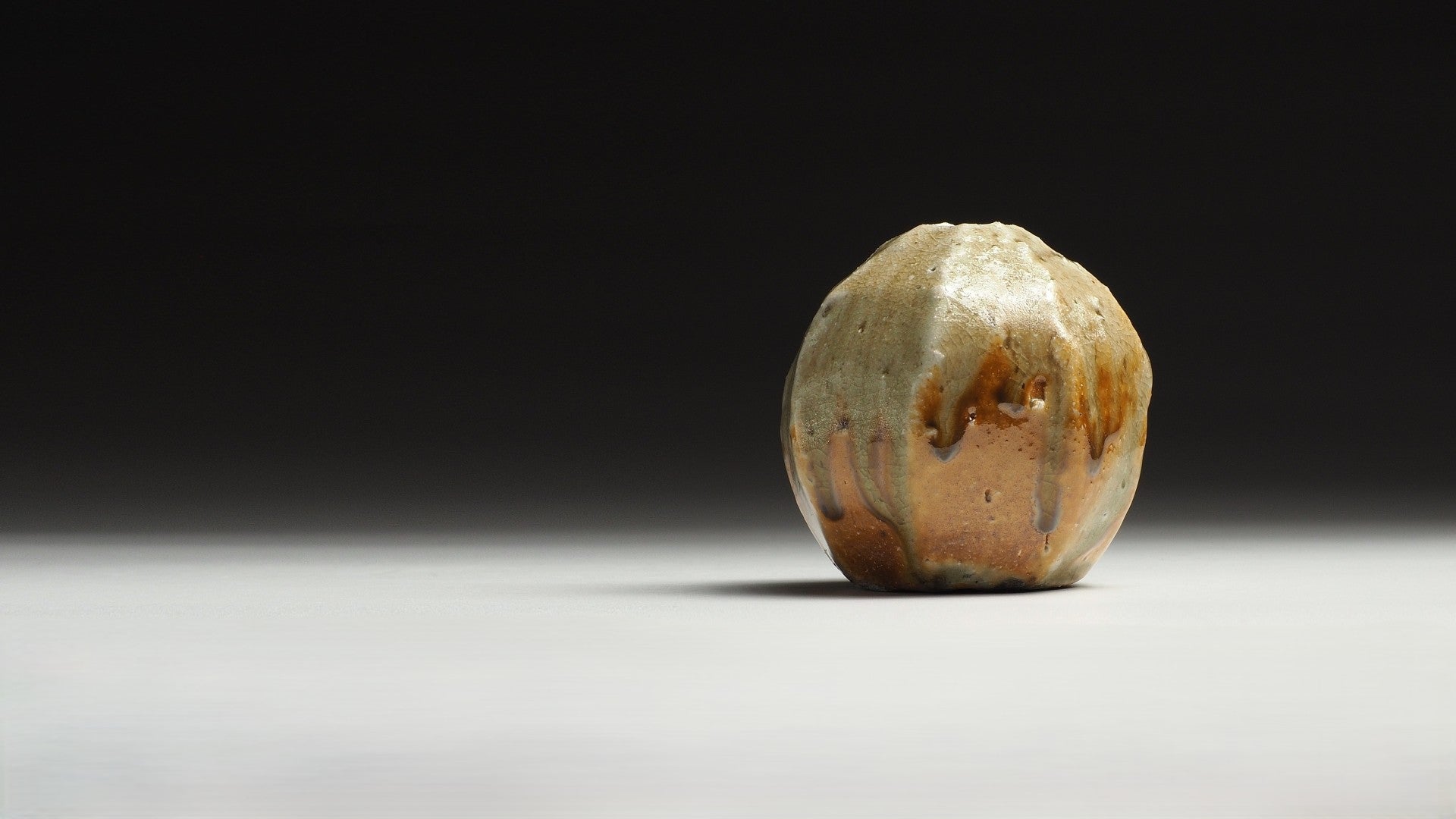
Setsugan, a Shigaraki vase by master potter Hitoshi Minagawa, showing the varied textures and natural firing effects of yakishime.
From the end of the Heian period, hard, water-resistant pottery was being produced at centres such as Tokoname, Bizen, Shigaraki and during the medieval period, similar high-fired wares appeared across several regions of Japan.
As the Osaka City Museum of Oriental Ceramics explains in its Overview of Japanese Ceramics, much of this early production consisted of everyday objects: storage jars, large vessels for water or grain, bottles and mortars.
Yakishime was, first of all, practical pottery.
Its visual character came from the same process. Because no prepared glaze covered the clay, the surface remained open to the effects of the firing.
Some pieces emerged dry and earthy, with the texture of the clay clearly visible. Others developed warm reds and browns, deposits of ash, dark firing marks or areas where ash melted into a genuine glass-like surface.
A Firing Tradition Found Across Japan
Yakishime describes how pottery is fired, not where it comes from.
Several historic pottery regions developed their own yakishime traditions, each shaped by local clay, kiln technology and firing practices.
The distinction is particularly clear when looking at Japan’s Six Ancient Kilns. Seto became strongly associated with glazed ceramics, while Echizen, Tokoname, Shigaraki, Tamba and Bizen developed major traditions of high-fired unglazed pottery.
This is why, for example, Shigaraki ware and yakishime are not interchangeable terms.
Shigaraki is a regional ceramic tradition with centuries of history. Yakishime is one important method of ceramic production within that tradition.
Bizen, Tokoname, Tamba and Echizen developed their own versions of yakishime as well, using different clays and producing very different surfaces.
Is Yakishime Glazed? Natural Glaze vs Applied Glaze
One of the most striking things about yakishime is that, as mentioned earlier, pottery made without an applied glaze can still emerge from the kiln with glossy, glass-like areas.
To understand why, it helps to distinguish between applied glaze and natural glaze.
Applied Glaze
In conventional glazed pottery, glaze material is deliberately applied to the ceramic body before firing.
During firing, the glaze material melts and forms a glass-like layer over the clay. Depending on its composition, the glaze can change the colour and texture of the piece, seal the surface and make it more resistant to staining.
The important distinction is one of process: with an applied glaze, the glaze-forming material is deliberately placed on the pottery before firing.
Natural Glaze
Natural glaze forms in a different way.
In a wood-fired kiln, burning wood gradually turns to ash. Some of that ash is carried through the kiln by hot air and flame before settling on the pottery.
If the temperature is high enough and the firing conditions are right, the ash can melt and react with the ceramic body, forming a glass-like surface even though no glaze was applied before firing.
This process can be seen across several historic Japanese yakishime traditions.
Shigaraki provides one of the best-known examples. During prolonged anagama* firing, wood ash settles naturally on the pottery and, where sufficient heat is reached, melts and reacts with the clay. One characteristic result is vidro (ビードロ), a translucent natural glaze whose name derives from the Portuguese word for glass.
Similar natural ash effects also developed in other historic yakishime traditions, including Tokoname and Tamba.
*Anagama (穴窯), literally “cave kiln.” See the section Why Anagama Firing Matters below for a fuller explanation.

Before and after anagama firing: unglazed clay on the left, and the finished piece on the right, transformed by flame, heat and naturally formed ash glaze.
The distinction between natural and applied glaze is therefore less about appearance than about how the glaze forms.
With applied glaze, the glaze-forming material is deliberately placed on the pottery before firing. Natural glaze develops during the firing itself through the interaction of clay, ash and heat.
There are also cases where the boundary is less clear. In Bizen, for example, the ash effect known as goma (胡麻), discussed later in this article, can form naturally when pine ash melts on the surface, but potters have also encouraged the effect by placing ash on the pottery before firing.
The chemistry may be similar, but the process and the intention are different.
How Is Yakishime Pottery Made?
There is no single kiln design or firing schedule shared by every yakishime tradition.
The basic principle, however, is straightforward: the clay is shaped, dried and then fired at high temperature without an applied glaze.
Historically, the exact process varied from one pottery region to another.
In Shigaraki, yakishime was traditionally fired for several days in wood-burning kilns. High temperatures hardened the ceramic body while flame, ash and changing kiln conditions altered its surface.
Echizen offers a well-documented example of the scale these firings could reach.
According to the Fukui Prefectural Ceramics Museum, historic Echizen anagama were tunnels built into hillsides and could reach around thirteen metres in length. They were capable of holding roughly a tonne of jars, bottles and mortars and could be fired for about a week at temperatures approaching 1,300°C (2,370°F).
Why Anagama Firing Matters
An anagama (穴窯) is a wood-fired kiln traditionally built into a slope. Its importance to yakishime lies not only in the heat it produces, but in the environment it creates around the pottery.
Conditions are never completely uniform inside the chamber: flame moves through the kiln, ash circulates through the hot air and settles unevenly, while temperature and atmosphere vary according to position.
A vessel facing the main path of the flame can emerge very differently from one placed in a more sheltered area, and even opposite sides of the same piece may develop completely different surfaces.
The kiln therefore does more than fire the pottery. It becomes part of the process that creates its appearance.
This does not mean that yakishime is simply the result of chance. The potter chooses the clay and shapes the form. He decides how the pieces are positioned, what wood is used and how the firing is managed.

Hitoshi Minagawa of Tsuchinoko Kiln stoking the anagama with pine wood during a week-long yakishime firing.
Over generations, ceramic traditions developed a detailed understanding of how these choices influenced the final result, making yakishime not simply the product of clay and fire, but of the constant interaction between material, firing conditions and the decisions of the maker.
A Short History of Yakishime in Japan
The roots of high-fired Japanese ceramics go back well before the development of the medieval yakishime traditions.
One important step came with the introduction of new kiln technology from the Korean Peninsula. From around the fifth or sixth century, immigrant craftsmen brought techniques that gave rise to Sue ware (須恵器), a hard, blue-grey stoneware fired at temperatures above 1,000°C in a reducing atmosphere and generally left unglazed.
Some Sue pieces also developed accidental deposits of natural ash glaze during firing, anticipating effects that would later become closely associated with Japanese wood-fired ceramics.

Sue ware jar from 8th-century Japan, with natural ash glaze formed during firing. The Metropolitan Museum of Art.
The Rise of Medieval Yakishime
From the late Heian period into the Kamakura period, major centres of high-fired pottery developed across Japan.
Tokoname became one of the largest and most influential.
Its technology spread beyond the region. Echizen developed under Tokoname influence in the late twelfth century, while Shigaraki followed during the Kamakura period.
Tamba emerged from an existing local tradition of sue ware while also absorbing techniques from the Tokai ceramic centres.
Bizen followed a different line, developing from older sue ware production around Oku in present-day Okayama Prefecture.
Despite their different histories, the objects produced in these regions were largely practical. Early Shigaraki pottery centred on jars, large storage vessels and mortars, while Echizen produced similar forms for storing water, sake, grain and dyestuffs. Medieval Tamba followed much the same pattern.
At this stage, yakishime was above all pottery for everyday use. Its later association with tea culture developed only when these functional wares began to be appreciated not just for what they were made to do, but also for the qualities of their clay, surfaces and firing effects.
From Everyday Vessels to Tea Ware
This new way of looking at functional yakishime became especially important as Japanese tea culture developed during the late Muromachi period. Rather than being valued only as practical objects, selected Shigaraki and Bizen vessels began to enter the tearoom, where their clay, natural surfaces and firing effects could be appreciated in a different context.
The Metropolitan Museum of Art notes that the tea master Murata Jukō* (1423–1502) introduced Shigaraki and Bizen vessels into the tearoom, while Takeno Jōō* (1502–1555) later incorporated household wares into his tea gatherings, giving existing objects a new aesthetic value through their use in a different setting.
At first, this did not necessarily mean producing pottery specifically for tea. Jars, buckets and other utilitarian forms could simply be selected and used as tea utensils. By the mid-sixteenth century, however, this relationship had begun to influence production itself, and kilns such as Bizen were making objects specifically for use in tea.
By the Momoyama period, the connection between Japanese ceramics and tea culture was firmly established. The rough clay, natural ash glaze, exposed minerals and variations created by wood firing were no longer seen only as consequences of the production process; they had become qualities to observe and appreciate in their own right.
*Murata Jukō (村田珠光) was an influential early tea master associated with the development of wabi-cha (侘茶), a form of tea culture that emphasized simplicity and restrained aesthetics.
Takeno Jōō (武野紹鴎), active in the following generation, further developed this approach and the appreciation of humble, everyday objects within the tea setting.
Reading the Surface: Clay, Fire and Keshiki
As explained earlier, yakishime developed differently across Japan, shaped by local clays, kiln structures and firing traditions. Among these regional expressions, Shigaraki offers a particularly useful example for understanding how clay and fire remain visible on the surface of the finished pottery.
For Tsukushi, based in Shiga Prefecture and working closely with Shigaraki artisans, it is also a natural point of reference. This does not make Shigaraki representative of every yakishime tradition, but its distinctive clay and well-developed vocabulary of firing effects make it especially useful for learning how to read a wood-fired surface.
The terms introduced below are associated primarily with the Shigaraki tradition, although many of the underlying phenomena can also be found in other forms of wood-fired pottery.
Shigaraki Clay and High-Temperature Firing
The character of Shigaraki ware begins with its clay.
Local deposits are connected to the ancient Lake Biwa geological strata, formed from sediments accumulated over millions of years in former lake beds and enriched by weathered material carried down from the surrounding granite and rhyolite.
A laboratory analysis published by the Shigaraki Ceramic Research Laboratory (信楽窯業技術試験場) examined one local clay in detail.
Its main mineral components included quartz, potassium feldspar, plagioclase and halloysite, together with minerals from the mica group. The clay also contained relatively coarse particles of quartz and feldspathic material.
The study noted that the balance between clay and feldspar gave the material good plasticity while allowing it to consolidate effectively during firing.
Not every Shigaraki clay deposit has exactly the same composition, but the analysis helps explain one of the characteristic features of the ware: mineral particles often remain clearly visible in the fired surface.
Traditional Shigaraki yakishime has long been fired in wood-burning anagama, a practice that continues among contemporary potters today. During prolonged firing at high temperature, clay, minerals, flame and ash interact directly, leaving their traces visible on the finished surface.
Keshiki, the Landscape of the Fired Surface
In ordinary Japanese, keshiki (景色) means “scenery” or “landscape.”
In ceramics, the word describes the visual landscape that appears across the surface of a vessel.
It is not a single firing effect.
Instead, keshiki is the overall relationship between colour, exposed minerals, ash deposits, glaze, texture and firing marks.
A single vessel may contain several of these effects at once.
Hiiro (火色 / 緋色)
Hiiro refers to the warm reddish or red-brown colour that develops in the fired clay.
Iron naturally present in the clay contributes to these tones during firing.
In Shigaraki, the result is often relatively warm and gentle compared with the darker surfaces produced by more iron-rich clay bodies.
Haikaburi (灰被り)
Haikaburi literally means “ash-covered.”
During wood firing, ash settles directly onto the pottery and fuses to the surface. When it does not melt completely into a smooth glaze, it can remain rough and granular.
The accumulation itself becomes part of the appearance of the piece.
Vidro (ビードロ)
Vidro is the natural glass-like glaze associated with traditional Shigaraki firing.
It develops when deposited wood ash remains at high temperature long enough to melt and react with the clay body.
The resulting translucent surface may range from blue-green to greenish-brown.
Its name derives from the Portuguese word for glass.
Koge (焦げ)
Koge describes dark brown to almost black areas that can sometimes resemble scorched earth or lava.
It develops where ash builds up heavily around a piece without fully melting and where local firing conditions allow carbon to affect the clay beneath.
Arare (霰) and Kani-no-me (蟹の目)
These are pale, rounded, glass-like points that appear on the surface.
At temperatures of roughly 1,250 to 1,280°C (2,280 to 2,340°F), feldspar particles within Shigaraki clay can begin to melt and become visible as white or translucent spots.
Arare means “hail,” while kani-no-me means “crab’s eyes.”
Ishihaze (石はぜ)
Ishihaze occurs when mineral particles, including quartz, become exposed or pushed towards the surface as the clay body contracts during drying and firing.
Small cracks may open around them because the mineral and the surrounding clay respond differently to changes in temperature.
Rather than being hidden beneath a glaze, the stone remains visibly embedded in the ceramic surface.
Nuke (抜け)
Nuke describes an area that received little direct flame during firing.
Because it was more protected, the clay may retain a quieter, less strongly altered colour.
The effect becomes particularly visible beside areas of warm hiiro. The contrast between the two is itself part of the vessel’s keshiki.
More Than a List of Firing Effects
These terms are useful for understanding yakishime, but a good piece is rarely interesting because it contains one particular effect.
What matters is how the different surfaces relate to one another.
One side may remain dry and warm, showing the fired clay clearly. Another may be covered by ash. A shoulder may carry a streak of translucent vidro, while the lower body remains coarse and granular.
A single piece of feldspar may interrupt an otherwise quiet field of red clay.
Deformation, cracks, exposed minerals and changes in texture can all become part of the visual character of the work.
The point is not that imperfection is automatically desirable.
Rather, yakishime does not visually separate the material from the process that transformed it.
The clay, minerals, flame and ash remain present in the final object.
Note on sources: the Shigaraki terminology and firing effects described in this section draw on exhibition panels at the Shigaraki Pottery Museum (信楽焼ミュージアム) and printed material from the Shigaraki ceramic park, consulted on site.
Other Japanese Yakishime Traditions
Shigaraki is only one expression of a much wider Japanese ceramic tradition.
Bizen, Tokoname, Tamba and Echizen all developed their own relationships between clay, kiln and fire.
The basic principle may be related, but the results are far from identical.
Bizen (備前)
Bizen ware, from present-day Okayama Prefecture, is one of Japan’s best-known yakishime traditions.
The Okayama Prefectural Government describes its basic process simply: the shaped clay is placed in the kiln without glaze and fired for a prolonged period using split pine wood.
Bizen has its own vocabulary for the marks created during firing.
- Goma (胡麻) describes scattered deposits of melted pine ash that resemble sesame seeds.
- Sangiri (桟切) develops particularly around vessels placed low in the kiln, where ash accumulates and airflow is restricted. Local reducing conditions can create greys, dark slate colours and blue tones.
- Hidasuki (緋襷) produces characteristic red lines. Historically, straw could be wrapped around a vessel to prevent it from fusing to neighbouring pieces during firing; the contact with the straw left a distinct colour on the clay.
-
Botamochi (牡丹餅) refers to circular marks created when a small pad of clay shields part of a dish from direct firing effects.
These effects have no exact equivalents in the Shigaraki vocabulary.
Yakishime traditions may share the same broad principle while developing completely different visual languages.
Tokoname (常滑)
Tokoname, in present-day Aichi Prefecture, was one of the largest ceramic production centres of medieval Japan.
Its jars and storage vessels were transported widely by sea and have been found from Tohoku in the north to Kyushu in the south.
Tokoname was also technically influential. Its kiln technology contributed to the development of several other medieval ceramic centres.
Surviving twelfth-century vessels provide some of the clearest early examples of natural ash glaze forming during anagama firing rather than being deliberately applied beforehand.
Tamba (丹波)
Tamba, in present-day Hyogo Prefecture, emerged during the late Heian period from an existing local sue ware tradition while absorbing ceramic technology from the Tokai region.
Like other medieval yakishime centres, its production focused heavily on jars, storage vessels and mortars.
One of its characteristic surfaces combines a warm brown fired clay body with a fresh green natural ash glaze.
Echizen (越前)
Echizen, in Fukui Prefecture, developed into an important centre for strong, practical ceramics.
Its pottery travelled by boat along the Japan Sea coast and was widely used for storage.
Local clay contains relatively high levels of iron, producing red-brown and darker surfaces after firing.
The durability and water resistance of Echizen ware made it particularly useful for vessels intended to hold water, sake, grain and dyestuffs.
Large jars, storage vessels and mortars formed the core of its historic production.
Across Bizen, Tokoname, Tamba and Echizen, the fundamental idea of high-fired unglazed pottery remains recognisable.
What changes is the clay, the kiln, the firing method and the history of each region.
How to Look at Yakishime Pottery
Understanding how yakishime is fired changes the way you look at it.
Instead of seeing only the overall shape, begin with the clay itself.
Is the surface fine or coarse?
Can you see mineral particles?
Does one area remain dry and granular while another becomes smooth or glass-like?
Then turn the piece and follow the surface around it.
In wood-fired pottery, flame and ash rarely affect every side in the same way.
A shoulder facing stronger flame may look completely different from the protected back of the vessel. Natural glaze may collect in one area while bare clay remains visible only a few centimetres away.
The Shigaraki term nuke explained earlier exists precisely because even an area that escaped the flame could become something worth observing.
The reverse, the foot and the transition between different textures can sometimes tell you more about the firing than the front of the object.
This also explains why two pieces made from similar clay and fired in the same kiln can look noticeably different.
They did not occupy exactly the same position. They were not exposed to exactly the same flame, temperature or ash.
At the same time, variation should not be confused with complete unpredictability.
The potter still created the form, selected the clay, positioned the work and controlled the firing.
A useful way to look at yakishime is to ask three questions:
- What comes from the clay itself?
- What seems to have happened during the firing?
- How do those effects interact with the form created by the potter?
For anyone looking at contemporary yakishime, these questions also help explain why two works from the same maker or series may differ visibly without either one being “wrong.”
Variation is part of the process.
Yakishime in Contemporary Japanese Ceramics
Yakishime did not disappear with medieval storage jars or historic tea utensils. Japanese potters continue to explore the relationship between clay and high-temperature firing, adapting an old ceramic principle to contemporary forms and different ways of working.
The continued use of the anagama is one of the clearest links with this history. Over time, the single-chamber anagama was joined, and in many production centres gradually replaced, by the multi-chamber noborigama (登窯), which was better suited to firing larger quantities of pottery and became closely connected with expanding commercial production.
Yet the anagama never disappeared completely. Contemporary potters continue to use it because prolonged wood firing produces surfaces that are difficult to reproduce by other means, with flame and ash creating natural variations of colour, texture and keshiki across the clay.
Contemporary yakishime, however, is not limited to one kiln or to the reproduction of medieval forms. Today its principles can be found in cups, tea ware, sake vessels, bowls, flower vases and sculptural ceramics, while individual makers continue to explore different relationships between clay, heat and the firing atmosphere.
The two approaches can be seen in the work of artisans represented by Tsukushi.
- At Tsuchinoko Kiln in Shigaraki, Hitoshi Minagawa follows a traditional approach, firing his pottery without applied glaze for approximately one week in a wood-burning anagama. Flame and pine ash interact directly with the clay, producing the natural colours, ash deposits and glass-like surfaces characteristic of Shigaraki yakishime.

Hachiryō octagonal cups by master potter Hitoshi Minagawa of Tsuchinoko Kiln, traditionally yakishime-fired in a wood-burning anagama.
-
Ohmi Ceramics, based in Kusatsu, offers a more contemporary interpretation of this relationship between material and firing. Its pottery is fired in a gas kiln rather than an anagama, with controlled heat and locally sourced, mineral-rich mud from the Lake Biwa area contributing to its characteristic dark surfaces.
The result is quite different from traditional wood-fired Shigaraki, but it shows how contemporary potters can continue to explore the underlying idea of allowing clay, minerals and firing conditions to shape the final appearance of the work.
Kokutama Chawanmushi Bowl by master potter Kazuma Yamamoto of Ohmi Ceramics, representing a contemporary approach to yakishime.
What continues, therefore, is not a fixed kiln, form or surface, but an interest in the transformation of clay through high-temperature firing. A contemporary cup may have little in common with a medieval storage jar in shape or function, yet both can reveal the same fundamental relationship between material, heat and the decisions of the maker.
Frequently Asked Questions About Yakishime Pottery
Is yakishime pottery glazed?
Yakishime is made without an applied glaze.
However, wood ash can settle on the pottery during firing and melt at high temperature, creating naturally glazed areas. For this reason, a yakishime piece may have glossy or glass-like sections even though no glaze was applied before firing.
Historic Shigaraki, Tokoname and Tamba all provide documented examples of this process.
What is natural ash glaze?
Natural ash glaze forms when ash from burning wood settles on pottery inside the kiln and melts at high temperature.
Unlike conventional glaze, the glaze-forming material is not deliberately coated onto the vessel beforehand. It reaches the pottery during firing and reacts with the clay to form a glass-like surface.
Is yakishime a type of Shigaraki ware?
Not exactly.
Yakishime is a method or tradition of high-temperature unglazed firing. Shigaraki is one of several historic Japanese pottery regions where yakishime developed.
Bizen, Tokoname, Tamba and Echizen also have important yakishime traditions.
Is all Shigaraki ware yakishime?
No.
Medieval Shigaraki was strongly associated with high-fired unglazed pottery, but the region later developed extensive traditions of glazed ceramics.
From the seventeenth century onwards, glazed pottery became an increasingly important part of Shigaraki production.
What creates the colours on yakishime pottery?
Yakishime colours come from the clay itself and from firing conditions. Minerals in the clay react to heat, while flame, kiln atmosphere and wood ash alter the surface. In Shigaraki, for example, iron creates warm hiiro, while ash can form haikaburi, translucent vidro or darker koge.
Why can yakishime pieces from the same firing look different?
Pieces occupy different positions in the kiln and receive different amounts of heat, flame and ash. Even opposite sides of one vessel can develop differently. The potter influences the result through placement and firing technique, but variation is a natural part of yakishime, so no two pieces are exactly alike.
%20is%20a%20form%20of%20Japanese%20pottery%20fired%20at%20high%20temperatures,%20generally%20around%201,200%20to%201,300%C2%B0C%20(2,190%20to%202,370%C2%B0F),%20without%20an%20applied%20glaze.Because%20the%20clay%20remains%20exposed%20during%20firi...)