
Japanese Tea Cups Made in Japan: How to Recognize Authentic Handmade Yunomi
You search for Japanese tea cups and find hundreds of listings.
Many say “handmade,” many say “Japanese style,” and some even carry the word “Japanese” in the title. A piece arrives and something feels off: too light, too perfect, too cold in the hand.
It was made in a factory, and probably not in Japan.
This guide exists so that never happens again, giving you the tools to tell the real thing from the rest before you buy.
- “Japanese Style” and “Made in Japan” Are Not the Same Thing
- The Regional Kiln Traditions: Why Origin Is Everything
- How to Read a Yunomi: The Physical Markers of Handmade Work
- What Authentic Handmade Yunomi Actually Cost, and Why
- Where to Buy Japanese Tea Cups Actually Made in Japan
- A Note from Tsukushi: What Sourcing Actually Looks Like
- FAQ: Authenticity and Provenance

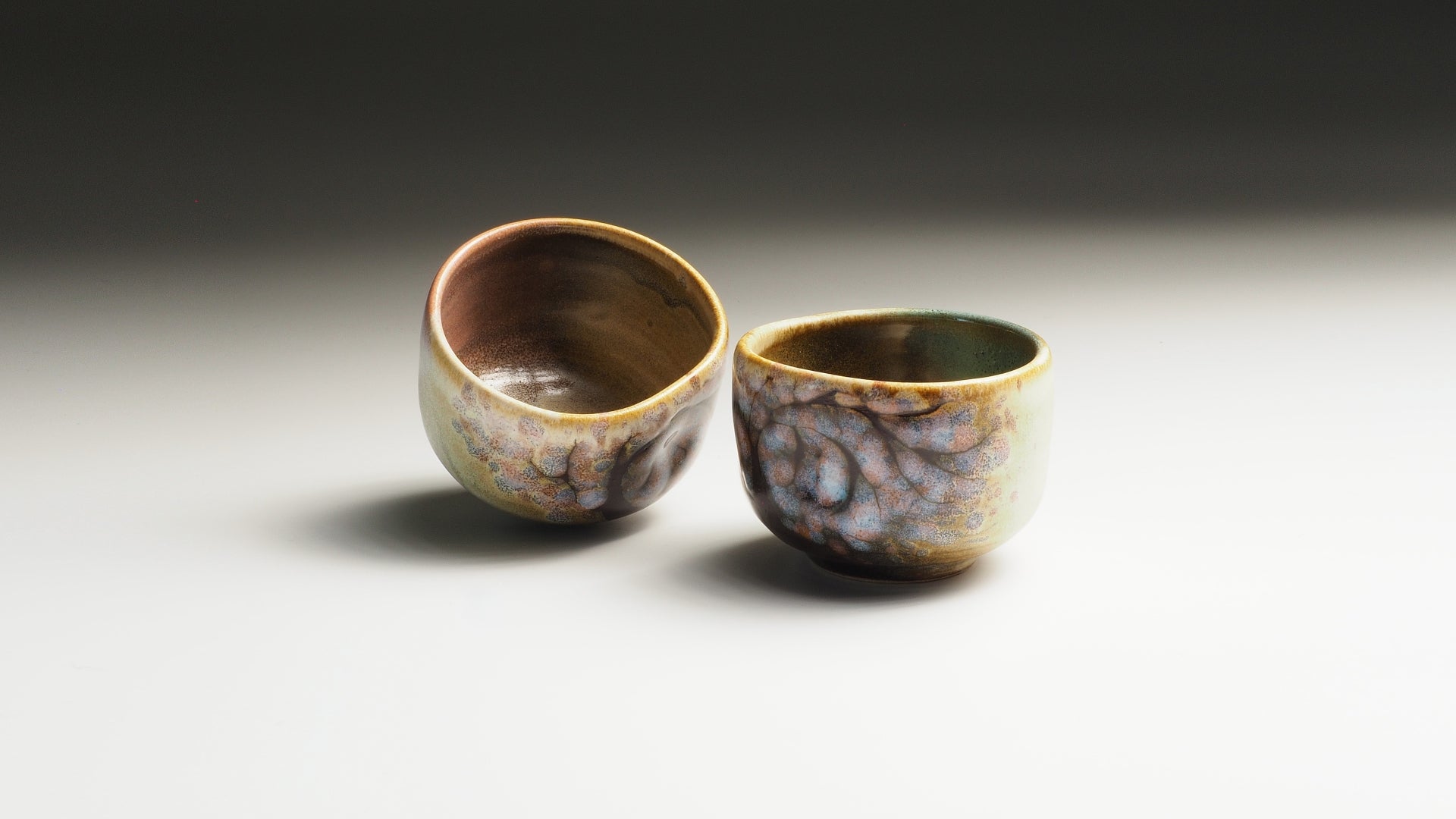
Close-up of the rims of handcrafted yunomi teacups by Kazuhiro Kojima, revealing refined control of clay shaping and glaze application.
“Japanese Style” and “Made in Japan” Are Not the Same Thing
“Japanese style,” “Japanese inspired,” and “Japanese design” are aesthetic descriptions that say nothing about where a piece was made, who made it, or how.
“Made in Japan” is a declaration of origin, meaning the piece was genuinely produced in Japan rather than simply designed or inspired there. These two types of language are not interchangeable, yet they are routinely treated as if they were.
This confusion extends beyond teacups to bowls, plates and Japanese craft in general.
A significant share of what is sold as Japanese ceramics on major online marketplaces is produced outside Japan, decorated with motifs that evoke Japanese aesthetics such as cherry blossoms, ink-wash patterns and indigo blue, at prices that make genuine Japanese craft production impossible.
A handcrafted piece rooted in the tradition of monozukuri (物づくり), the Japanese philosophy of making things with care, devotion and deep respect for the material, belongs to an entirely different world from a factory-made object designed to look similar.
The price point is almost always the first signal.
If a listing offers a “handmade Japanese Yunomi” for $12, the word “handmade” is doing a great deal of work it has not earned.
Curators like Tsukushi source exclusively from artisans they know by name, in workshops they have visited, in regions of Japan where these traditions have existed for centuries.
When a piece is described as “made in Japan” by a curator with direct sourcing relationships, it means a specific person, in a specific place, shaped it by hand.
The Regional Kiln Traditions: Why Origin Is Everything
Japan does not have one ceramic tradition. It has dozens, each rooted in a specific geography, a specific clay and a specific history.
When a piece is genuinely made in Japan by an artisan working within one of these traditions, it carries markers, visual, tactile and historical, that are simply not reproducible by generic production.
Understanding the main traditions relevant to Yunomi teacups (湯呑) gives you a vocabulary for evaluating what you are looking at.
The following are some of the most significant production areas, though Japan’s ceramic landscape is far richer than any single list can capture.
For a comprehensive overview of Japan's ceramic heritage and the Six Ancient Kilns, see Highlighting Japan, March 2026: Exploring Japanese Pottery, published by the Government of Japan.
Shigaraki (信楽焼) — Shiga Prefecture
Shigaraki is one of Japan’s Six Ancient Kilns, a small town in Shiga Prefecture and the source of one of Japan’s most distinctive ceramic clays.
The clay, drawn from the mountains around Shigaraki, is iron-rich and coarse, producing pieces with a distinctive rough texture, warm orange and reddish-brown tones and a natural ash glaze that forms where kiln ash settles on the surface during firing.
No two pieces are identical because the kiln does part of the work, and the results are never entirely predictable.
A genuine Shigaraki Yunomi feels substantial in the hand, with a surface texture you can feel with your thumb. The foot, the unglazed ring on the base, shows the raw clay in its natural state with visible grog and mineral specks. It does not look refined, and that is precisely the point.
Worth noting: many potters from areas surrounding Shigaraki work with Shigaraki clay even when their kilns are located elsewhere in the prefecture or in neighboring Kyoto, carrying the tradition beyond its geographical center.
Mino (美濃焼) — Gifu Prefecture
Mino ware accounts for a large share of Japan’s ceramic production and encompasses an enormous variety of styles, from the milky white of Shino to the bold green of Oribe.
For Yunomi specifically, Mino pieces tend toward a softer and warmer aesthetic, with glazes that pool naturally and surfaces that reward close inspection.
Mino has many centuries of history, and the best pieces from this region carry that weight in the clay, the glaze behavior and the proportion of the form.
Hagi (萩焼) — Yamaguchi Prefecture
Hagi ware is particularly prized among serious tea practitioners.
Made from soft and porous clay, Hagi Yunomi change over time as the clay absorbs tea slowly and the glaze develops subtle color shifts with repeated use.
This process, called Hagi no nanabake (萩焼七化け, the seven transformations of Hagi Yaki), is considered one of the great pleasures of owning a Hagi piece.
A Hagi Yunomi bought today will look different in five years, and more beautiful for it.
Tokoname (常滑焼) — Aichi Prefecture
Tokoname, also one of Japan’s Six Ancient Kilns, is known for precision and refinement. Yunomi from this tradition tend to be lighter, more even in wall thickness and feature a smoother and more controlled glaze. The clay has a naturally fine grain that fires to a clean, dense surface.
Tokoname pieces are less obviously rustic than Shigaraki or Hagi, and their authenticity lies in their exactness, which paradoxically can make imitations harder to detect at first glance. Provenance and the potter’s mark matter here more than anywhere.
How to Read a Yunomi: The Physical Markers of Handmade Work
Before buying, online or in person, there are specific things to look at. These are observable details that distinguish a hand-thrown piece from a cast or machine-finished one.
Modern industrial technology has significantly raised the quality of imitations, making some mass-produced pieces harder to distinguish at a glance than they once were.
Yet what industrial production cannot replicate is the philosophical core of Japanese ceramic aesthetics: the idea, expressed in the concept of wabi-sabi, that true beauty lies in imperfection and in the visible trace of human making.
The markers below are not flaws; they are the very qualities that define a handmade piece.
The Foot (高台, Kōdai)
Turn the cup upside down. The unglazed foot ring is where a handmade piece reveals itself most clearly. On a genuine hand-thrown Yunomi, the foot will show:
- Slight irregularity in width or height around its circumference
- The raw clay in its natural state with texture, color and mineral variation
- Tool marks from where the potter trimmed the base on the wheel
- Possibly natural fire marks or ash deposits if kiln-fired traditionally
On a mass-produced piece, the foot is uniform, smooth and often too clean. It looks machined because it was.

The kōdai (高台), or foot, of a handcrafted Japanese yunomi teacup, revealing raw clay and subtle irregularities from the handmade process.
The Lip
Run your finger around the rim of the cup. A hand-thrown lip has very slight variation in thickness, not enough to be uneven, but enough to feel alive under your fingertip.
On a slip-cast or machine-finished piece, the rim is perfectly consistent all the way around. That perfection is the tell.
Glaze Behavior
Handmade glazes do not behave uniformly. Look for areas where the glaze thickens toward the base, forming a slight drip or pooling, thinning or color shift near the rim where glaze runs thin during firing, and variation in surface sheen between areas that are more matte and those more reflective.
In wood or anagama-fired pieces, natural ash deposits create unpredictable surface effects that no industrial process can imitate. A uniform and perfectly even glaze from top to bottom is almost always a sign of industrial production, regardless of what the listing says.

Glaze drips, shifting tones, and subtle variation in rim thickness on a handcrafted Japanese yunomi teacup.
The Potter’s Mark (款識, Kanshiki / 陶印, Tōin)
A genuine artisan piece will almost always carry a mark on the base. This can take the form of a stamp (陶印, tōin), an incised signature or a painted kiln mark, collectively known as 款識 (kanshiki).
Whatever its form, the mark is the potter’s declaration of authorship, connecting the piece to a specific person and a specific workshop. If you search the name or symbol, you should be able to find the maker.
A piece sold as “handmade by a Japanese artisan” with no mark, no name and no traceable origin is missing something important.
A serious curator will always link every piece to a named maker and a documented workshop, because anonymous craft should not be part of a trusted collection.

The potter’s mark (陶印, Tōin) carved into the unglazed clay foot of a handmade Japanese yunomi teacup.
Note: for those who want to explore foot types and other traditional Japanese pottery techniques in greater depth, The Japanese Pottery Handbook by Penny Simpson, Lucy Kitto and Kanji Sodeoka (Revised Edition, Kodansha) is a reliable and accessible reference.
What Authentic Handmade Yunomi Actually Cost, and Why
This is the question that most listings avoid answering directly, so we will. Understanding the real cost structure of handmade Japanese teaware helps you evaluate any piece you encounter, not just ours.
Making a Yunomi by hand involves sourcing regional clay, preparing and aging it, throwing each piece individually on a wheel, trimming and refining after initial drying, applying glaze by hand and firing in a kiln that requires careful monitoring and significant fuel cost.
Each of these steps takes time that industrial production simply does not spend.
A quality handmade Yunomi from a respected Japanese artisan will generally start above $30, with prices varying according to the size of the production batch, the complexity of the glazing technique and the firing method used. Pieces from well-known or award-winning potters, or those made with particularly rare clays or traditional firing processes, can go significantly higher.
This is not a premium for the sake of it: it reflects the actual time, material and craft invested in each piece.
A handmade Yunomi is also worth keeping in a way a factory cup is not.
The glaze develops with use, the surface records touch and time, and the piece becomes more itself over the years. That is the nature of the material.

Handcrafted Japanese teacups by artist Kawai Taichi, a refined expression of wabi-sabi beauty in pottery.
Where to Buy Japanese Tea Cups Actually Made in Japan
Knowing what to look for is half the answer, and knowing where to look is the other half. Honest sources for genuine Japanese handmade teaware share certain characteristics: they name their artisans, they explain their sourcing and they do not compete on price with mass-market platforms.
Specialist shops that source directly from Japan are the most reliable option for international buyers. They carry pieces with full provenance, meaning maker name, kiln tradition and region of origin, and their curation reflects genuine relationships with Japanese workshops.
The question to ask of any seller is straightforward: who made this, and where? A seller who can answer clearly is worth trusting. A seller who cannot is telling you something important.
What to avoid is equally clear: any listing that uses “Japanese style,” “Japanese inspired” or “Japanese design” without specifying a maker and a place of origin, any price point that cannot honestly reflect handmade Japanese craft production, and any listing without photos of the base showing the potter’s mark.
A Note from Tsukushi: What Sourcing Actually Looks Like
Selecting craft of a certain level is not simply a matter of aesthetic taste. It requires careful research into production methods, materials and the quality that makes a piece genuinely one of a kind.
But identifying the right product is only the beginning. What follows is what we at Tsukushi consider the essential condition that separates a cold factory-made object from something created by hand with intention: mutual trust.
In Japan, the relationship between an artisan and a curator must be built on solid ground. An artisan places their image, their work and their name in the hands of someone else. Through that trust, craft traditions passed down through generations reach people far beyond Japan, while the artisan is also supported through the process.
When we begin a collaboration at Tsukushi, we do so with full respect for the artisan’s work and, above all, for their time.
A small artisan working in a family kiln, or sometimes alone, produces pieces of extraordinary quality but in limited quantities. We do not see this as a constraint. We see it as a strength, something to elevate: a reminder that quality requires time, and that time has a value we have collectively forgotten in the age of fast production.
One of the most moving experiences of visiting an artisan kiln is seeing the unfired pieces waiting for their first firing. The form is already complete, already mature, but the raw color of the clay still conceals the transformation about to happen inside the kiln.
When the pieces are finally extracted, still warm, the change in temperature makes them ring softly, like small bells. It is a sound that is difficult to forget.

Yuri Onnis of Tsukushi, left, visiting Nunobiki Pottery with artisan Kojima Kazuhiro, center, and Kojima Ryoko, right.
There is also the experience of listening to the artisans themselves: learning how certain traditions have been passed from parent to child across generations, discovering how an entire life has been devoted to the art of ceramics, and understanding that for most of these makers, the deepest recognition they seek is simply to be appreciated by the people who use their work.
Local materials, living traditions, a constant connection to the community: these are what make Japanese artisan craft something more than an object. This is our modus operandi at Tsukushi, and the reason we work the way we do. Tradition, history, sustainability and ethical practice.
We hope that one day you will hold one of these pieces in your hands and feel, even in part, what we feel when we are there.
FAQ: Authenticity and Provenance
The questions below are the ones buyers ask most often when trying to navigate a market where authenticity is not always easy to verify. If you have a question not covered here, feel free to reach out to us directly.
How can I tell if a Japanese teacup is genuinely made in Japan?
Look for three things: a named maker or kiln mark on the base, a price point consistent with handmade Japanese craft production, and a seller who can tell you specifically who made the piece and where. If any of these are missing, ask directly. A legitimate source will always be able to answer.
What does “handmade” actually mean for a Japanese Yunomi?
In the context of Japanese ceramics, handmade means wheel-thrown or hand-built by an individual potter, trimmed and finished by hand, glazed individually and kiln-fired in a traditional or craft kiln. It does not mean assembled in a factory setting, which is how the term is sometimes used on mass-market listings.
Is a more expensive Yunomi always better?
Not automatically, but price is a reliable minimum filter. A genuinely handmade piece from a named Japanese artisan has a cost floor that industrial production cannot reach. Below a certain point, the claim of handmade Japanese origin is almost always false. Above it, quality varies by maker, tradition and individual piece, which is exactly why curation and direct sourcing relationships matter.
Where can I find authentic handmade Yunomi outside Japan?
Specialist shops with direct sourcing relationships in Japan are the most reliable option. Look for sellers who publish the name of the maker, the kiln tradition and the region of origin for each piece. Whether you buy through a dedicated Japanese craft shop or directly from a potter’s own channel, the standard is the same: full provenance, clearly stated.