

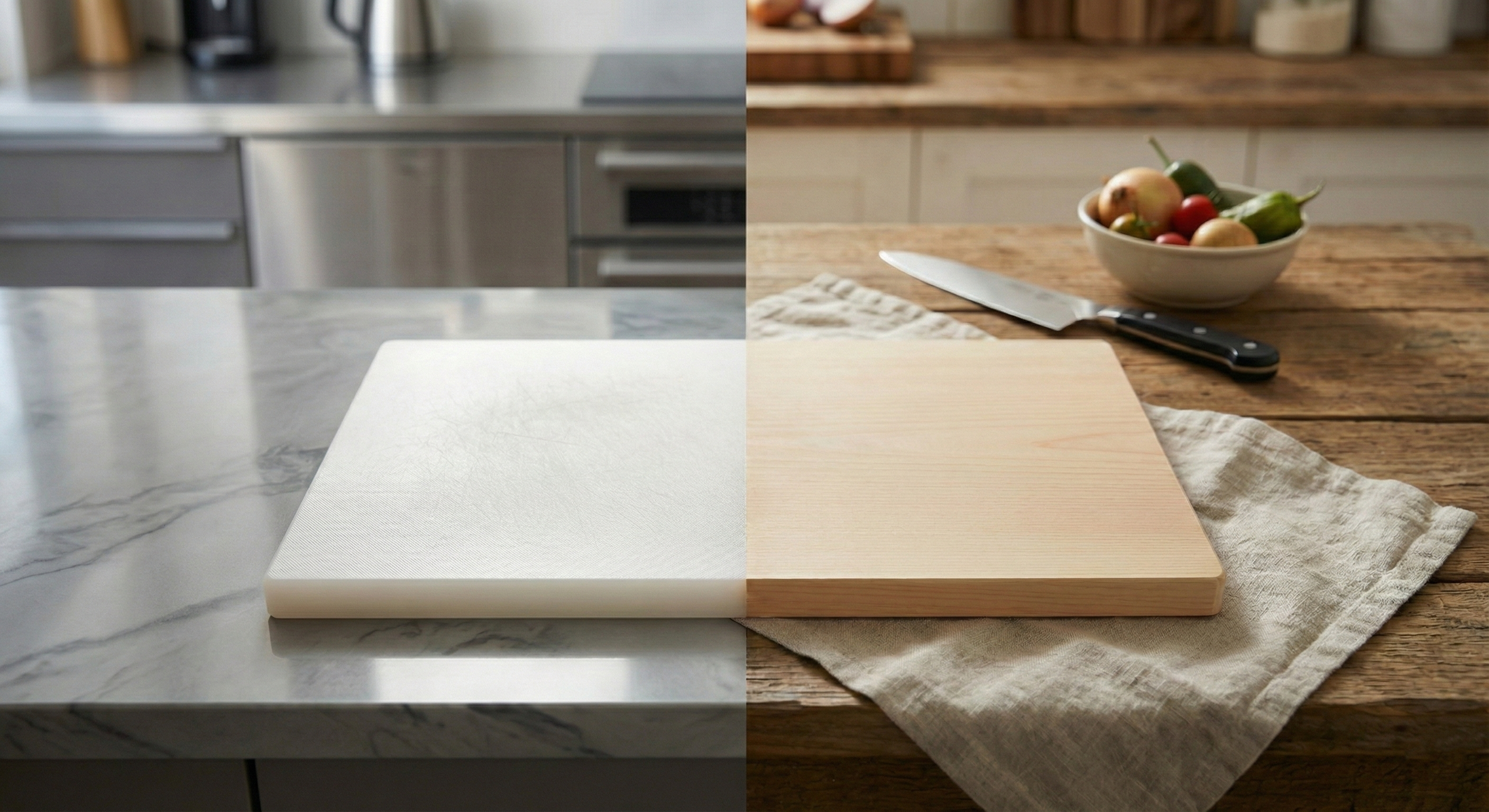
Are you eating plastic? Why science favors wood cutting boards
Recent research identifies plastic cutting boards as a significant source of microplastic ingestion, shedding millions of particles during use.
This article examines the peer-reviewed evidence regarding microplastic shedding, explores the bacterial resilience of traditional wooden surfaces, and highlights why natural wood cutting boards like a Japanese Manaita (especially if crafted from Hinoki wood) are the ultimate non-toxic, high-performance solution for the health-conscious kitchen.
- What Are Microplastics in Food? The Science of Shedding
- Why Plastic Cutting Boards Aren't Safer Than Wood: The Hygiene Paradox
- The Japanese Manaita: A Masterclass in Material Science
- Hinoki’s Natural Antimicrobial Properties
- How to Avoid Microplastics in Cutting Boards: A Buyer’s Guide
- Can an eco-friendly cutting board prevent microplastic pollution?
- Non-Toxic and Microplastic-Free Cutting Boards: FAQ
What Are Microplastics in Food? The Science of Shedding
When we discuss the "hidden health hazards" of the modern world, we often focus on air quality or water filtration.
However, the very surface upon which we prepare our fresh, organic produce may be one of the most direct contributors to plastic consumption.
To understand how to avoid microplastics in food, we must first identify their source.
Microplastics are defined as plastic particles less than five millimeters in size. While many enter the food chain through environmental pollution, a significant portion is generated right on our countertops.
A landmark 2023 study published in Environmental Science & Technology by researcher Himani Yadav and her team at North Dakota State University provided the "smoking gun" for this issue.
Microplastics in cutting boards: The Yadav Study Findings
The research team performed a series of tests to quantify the amount of plastic released during routine chopping.
They found that a single person could be exposed to between 14 to 71 million microplastics annually from polyethylene boards. If the board is made of polypropylene, the shedding is even more severe, potentially reaching 79 million particles per year.

This isn't just a matter of "shavings" you can see; these are microscopic fragments that adhere to the moisture in vegetables and meat. For those searching for a microplastic free cutting board, these figures are a call to action.
We are no longer talking about abstract environmental concerns, but about material that enters our bodies daily through the simple act of preparing a meal.
Why Plastic Cutting Boards Aren't Safer Than Wood: The Hygiene Paradox
For years, the marketing behind synthetic boards claimed they were "more hygienic" because they are non-porous. However, scientific literature (and the experience of professional chefs) suggests the opposite.
Bacterial cross-contamination: The Danger of the "Knife Scar"
The primary issue with plastic is its lack of "structural memory."
When a sharp steel blade hits a plastic board, it creates a deep groove. Over time, these boards become covered in microscopic "scars."
A study from the University of Wisconsin (Ak, Cliver, & Kaspar) discovered that bacteria like Salmonella and E. coli can retreat into these narrow grooves, where they are protected from the mechanical action of a sponge and the high heat of a dishwasher.
Natural antimicrobial properties: The Defense of Wood
In contrast, a non-toxic cutting board made of wood possesses a capillary structure.
When bacteria land on a wooden surface, they are drawn down into the grain. Deprived of the oxygen and moisture they need to survive on the surface, the bacteria eventually die off through a process of desiccation (drying).

When you use an authentic manaita, the material isn't just a passive surface; it is a biologically active barrier that manages microbial life far more effectively than scarred plastic.
The Japanese Manaita: A Masterclass in Material Science
In the world of professional Japanese culinary arts, the manaita is considered as essential as the knife itself. This is particularly true for boards made from Hinoki (檜, Japanese Cypress).
Hinoki’s Natural Antimicrobial Properties
Hinoki wood (botanical name Chamaecyparis obtusa) is naturally saturated with phytoncides, organic compounds like alpha-pinene and borneol.
In nature, these compounds protect the tree from fungal rot and insect damage. In the kitchen, they provide a built-in defense mechanism.
If you are looking for where to find non-toxic cutting boards with antimicrobial properties, Hinoki is the gold standard. It doesn't require chemical coatings or toxic lacquers; the wood itself is the sanitizer.
Best board for Japanese knives: Protecting the Steel
Beyond health, there is the matter of performance.
High-end Japanese knives are crafted from hard, brittle steel. Striking a hard plastic or rubber surface creates "rebound" energy that can dull or chip a fine edge.
Hinoki is a "soft" hardwood. It has a subtle "give" that cushions the blade.
This not only prevents microplastic shedding but also ensures your knives stay sharper for significantly longer.
How to Avoid Microplastics in Cutting Boards: A Buyer’s Guide
Transitioning to a microplastic free cutting board is one of the simplest yet most impactful changes you can make for your kitchen's health profile. But what should you look for?
-
Avoid Synthetic Coatings: Many mass-market wooden boards are coated in polyurethane or cheap glues. A true manaita should be "unfinished" or treated only with food-grade natural oils.
-
Verify the Source: Sustainably sourced Hinoki or Ginkgo from Japan ensures you are getting a board with the correct density and natural oil content.
-
Solid Wood (一枚板, Ichimai-ita): For a truly non-toxic experience, prioritize boards carved from a single, solid piece of wood.
Unlike laminated boards (edge or end grain), solid wood manaita do not require industrial glues or adhesives, ensuring that your food never comes into contact with synthetic resins.
More on the natural grain of solid wood manaita in this article: Masame vs. Itame: Board Grain Explained

Close-up of the natural grain direction in a handcrafted Japanese solid wood cutting board (一枚板, ichimai-ita).
When people ask, "What materials in cutting boards are least likely to shed microplastics?", the answer is always high-quality, long-fiber natural wood.
It is the only material that improves the more you use it, rather than degrading into harmful pollutants.
Can an eco-friendly cutting board prevent microplastic pollution?
The final argument for the manaita is one of environmental legacy.
Plastic boards are essentially "pre-trash." Once they are too scarred to be safe, they are discarded into landfills where they will take 500 years to break down.
An authentic hinoki cutting board is a piece of the circular economy. Crafted from wood sourced through sustainable forestry practices that align with global Sustainable Development Goals (SDG), it is a pure, organic material that is fully biodegradable and, last but not least, durable.
At Tsukushi, we believe in the "last cutting board you’ll ever buy."
A wooden board can be sanded down and refinished, lasting for decades and eventually returning to the earth without leaving a trace of polymer pollution behind.
You can explore our full collection of sustainable Manaita here.
Non-Toxic and Microplastic-Free Cutting Boards: FAQ
To help you make the most informed decision for your kitchen and your health, we’ve compiled answers to the most common questions regarding microplastics, hygiene, and the benefits of traditional Japanese wooden boards.
Do plastic cutting boards put microplastics in food?
Yes.
Scientific research, including the 2023 Yadav study, confirms that the friction between a steel knife and a plastic board shaves off millions of microscopic polymer fragments. These particles adhere to moisture in food and are ingested.
Switching to a natural wood cutting board is the most effective way to eliminate this source of microplastic consumption in your daily diet.
How to avoid microplastics in cutting boards?
The most direct method is to replace all synthetic surfaces (including those made of polyethylene, polypropylene, or hard rubber) with natural wood.
Opt for high-quality, non-toxic cutting boards made from solid wood.
We suggest Japanese Hinoki as this wood is "self-healing", meaning it does not break down into fragments, ensuring your food remains free from synthetic chemical shedding.
Where can I buy cutting boards that do not release microplastics?
Because all solid wood is microplastic-free, you can find safe options at most high-quality kitchenware retailers. However, it is essential to look for "solid wood" or "Ichimai-ita" (single-piece) boards to ensure no glues or resins are used.
For those seeking the highest standard of Japanese craftsmanship, specialists like Tsukushi offer authentic Hinoki boards made with natural materials and free from synthetic additives or industrial coatings.
Are there eco-friendly cutting boards that avoid microplastic pollution?
Yes. Natural wood boards are the ultimate eco-friendly choice.
Unlike plastic boards, which contribute to global microplastic pollution and cannot be recycled once contaminated, a wooden manaita is biodegradable.
Choosing sustainably sourced wood from Japan supports traditional forestry and provides a carbon-neutral alternative that will eventually return to the earth as organic matter rather than permanent waste.
What are the best non-toxic cutting boards available for home kitchens?
The highest-rated non-toxic boards are crafted from antimicrobial woods like Hinoki (檜, Japanese Cypress).
These boards are naturally resistant to mold and bacteria due to their organic phytoncide content. For a professional-grade experience, look for boards that are at least 2cm thick, which allows the wood to breathe and prevents warping, ensuring a safe, stable, and chemical-free cutting surface.
Which materials in cutting boards are least likely to shed microplastics?
Organic materials such as wood, bamboo (if glue-free), and stone, as well as inorganic materials like stainless steel, are the only options that are 100% microplastic-free. However, wood (specifically Japanese Hinoki) is preferred over other materials.
While stainless steel is hygienic, it is too hard for the knife edge, causing rapid dulling or rolling of the blade. Wood is the safest choice for both your health and the longevity of your cutlery.


