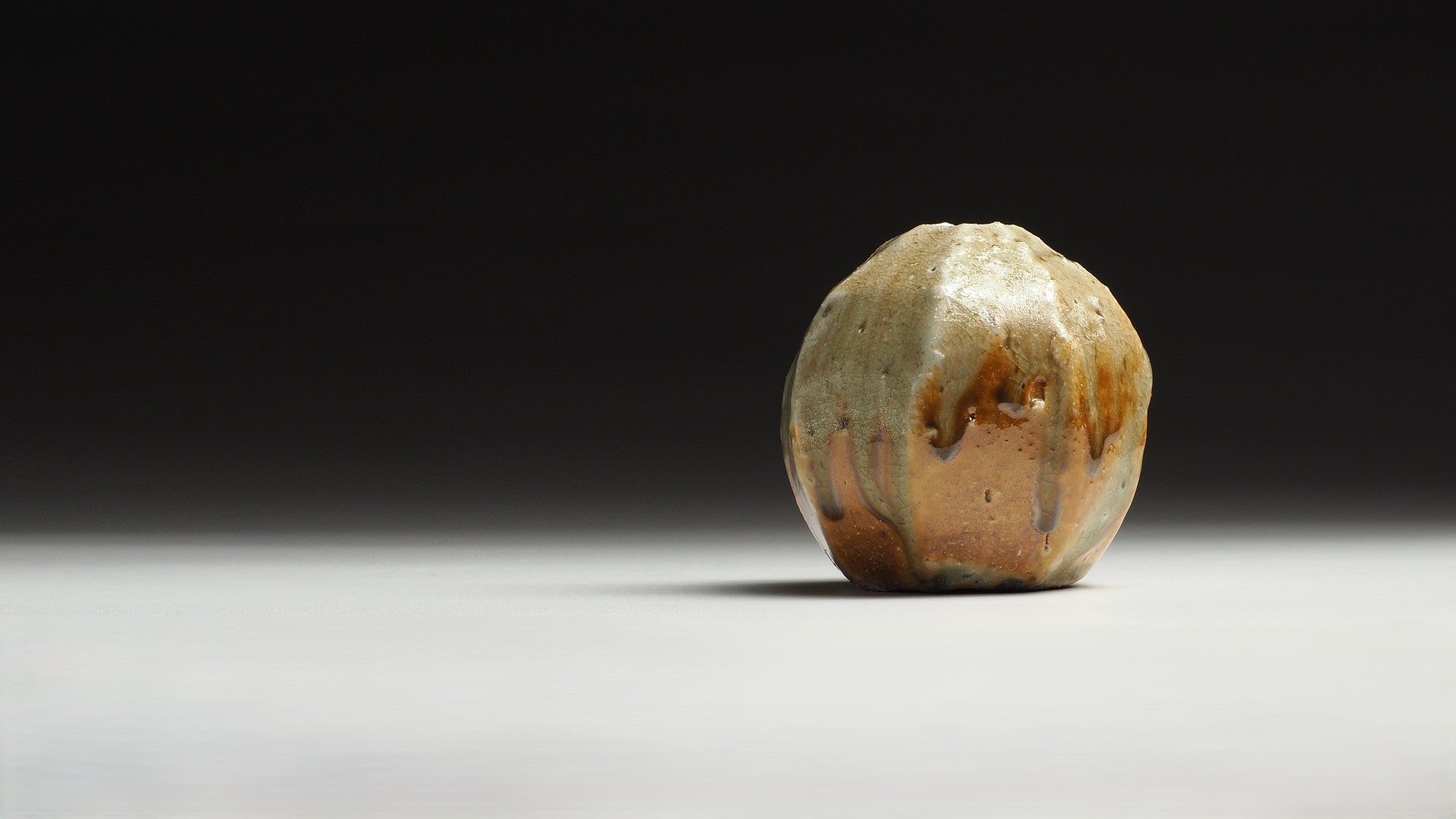

Article: Kannyū (貫入): The Fine Lines of Japanese Crackle Glaze
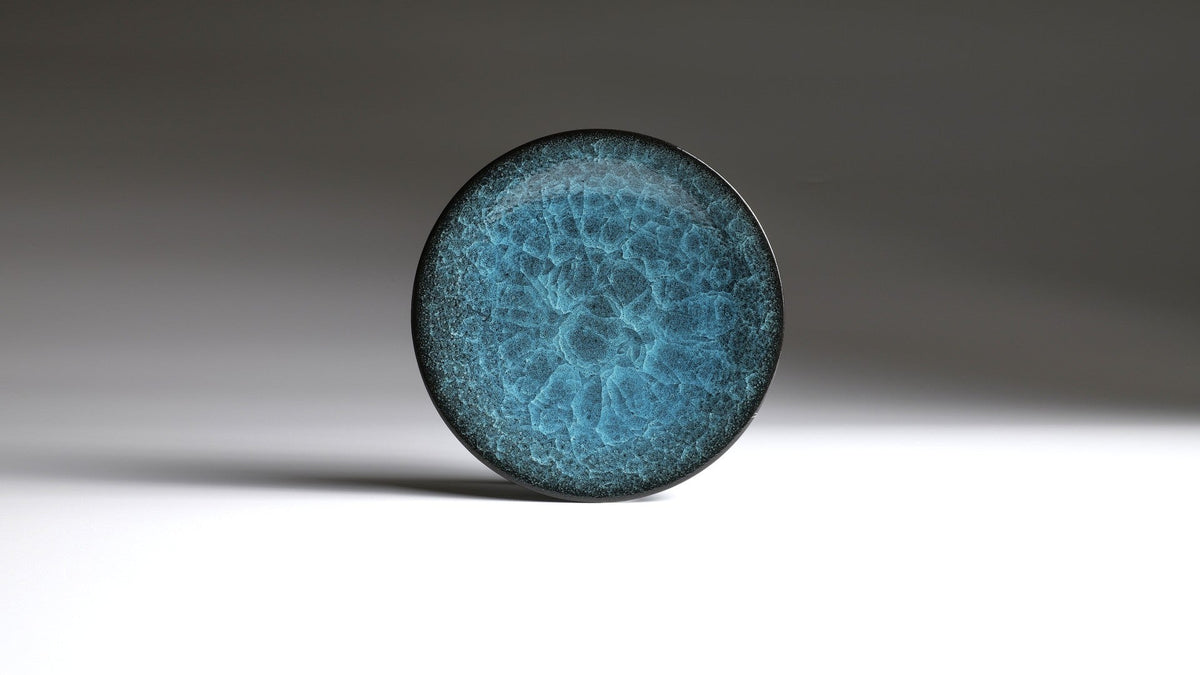
Kannyū (貫入): The Fine Lines of Japanese Crackle Glaze
Kannyū (貫入) refers to fine networks of cracks that develop within a ceramic glaze when it contracts differently from the clay body during cooling. Unlike structural fractures (hibi ヒビ), these cracks remain strictly within the glaze rather than extending through the clay beneath. In Japanese artisan pottery, kannyū is deliberately cultivated for its depth and distinctive visual character.
On a finished ceramic cup, these cracks (crackle) appear as fine lines across the glazed surface. They may be barely perceptible or immediately striking, forming anything from delicate, closely connected webs to broader, irregular patterns reminiscent of fractured ice or a landscape seen from above.
Understanding how these patterns emerge offers a deeper way to appreciate one of the defining signatures of Japanese glazed pottery.

Detailed view of the Suiri ramen bowl by Taichi Kawai, showcasing the intricate layers of Hyōretsu Kannyū ice-fracture glaze and shifting teal tones across the form.
How Does Kannyū Form in a Ceramic Glaze?
A crackle pattern never emerges from the glaze in isolation. Rather, it reflects the interplay between the underlying clay body, the chemical composition of the glaze, and the way the vessel is fired and cooled. Together, these elements explain both why kannyū forms and the remarkable variety of its patterns.
The Relationship Between Clay, Glaze and Cooling
A ceramic glaze begins as a suspension of mineral ingredients applied to the surface of a shaped clay vessel. In the intense heat of the kiln, these minerals melt into a glassy layer that fuses to the ceramic body. As the kiln cools, both the glaze and the clay begin to contract, yet they rarely shrink at the exact same rate.
When a glaze is formulated to contract more rapidly than the clay body beneath it, tension builds within the hardening glass. Once that tension exceeds what the glaze can withstand, a network of fine fractures opens to release the stress, creating the interconnected lines we know as kannyū.
Mastering this effect requires an intimate knowledge of how raw materials behave under heat and during the slow cooling cycle*. By selecting specific clay bodies and adjusting glaze recipes, a potter can deliberately invite this tension.
Often, as the warm vessels are drawn from the kiln and continue to settle at room temperature, the opening of new micro-fissures is accompanied by a faint, high-pitched pinging sound: a crystalline resonance known in Japan as kannyū-on (貫入音).
* Technical note: The Mie Prefecture Industrial Research Institute outlines several methods for controlling glaze crazing, specifically examining how adjustments to raw materials and firing conditions either induce or prevent kannyū. (Source in Japanese.)
Why Are Kannyū Patterns Never Exactly Alike?
Although the underlying physics remain the same, the visual character of kannyū shifts dramatically depending on glaze thickness, mineral composition, and placement within the kiln. While some glazes develop a dense network of fine lines, others form larger, more open patterns with cracks intersecting at unexpected angles.
A potter can certainly guide the glaze toward a particular crackle effect, but that does not mean dictating the exact placement of every single line. This is worth keeping in mind when comparing works from the same maker: even when identical glazes are applied in equal measure across a single series, no two crackle patterns will ever look the same.
It is this delicate balance between technical mastery and the raw, unpredictable nature of the kiln that makes kannyū so captivating, not merely as an end result, but as a living dialogue between artisan and material. Each surface reflects a process shaped by human hands without ever being fully controlled.
And it is precisely here that the Japanese concept of keshiki comes into play.

Side-by-side comparison of two Sake sets from the same series, highlighting how hand-throwing nuances and kiln reactions produce distinct keshiki landscapes and individual kannyū patterns on every vessel.
Keshiki: Seeing a Landscape in the Glaze
In Japanese ceramic appreciation, the term keshiki (景色) means "scenery" or "landscape."
As we saw with unglazed yakishime stoneware, where kiln fire and wood ash leave raw, unpredictable marks directly on bare clay, keshiki describes a specific way of looking at a vessel.
Instead of judging a piece only by the symmetry of its form, the eye lingers on the details of its surface: the way a glaze pools near the foot, subtle shifts in mineral colour, and the quiet textures left behind by the maker's hands and the heat of the kiln.
Within the tradition of Japanese tea ceramics, this appreciation of surface scenery relies as much on the observer's eye as on the physical traits of the clay and glaze. Kannyū is a clear expression of this sensibility.
Across a glazed cup, the network of fine cracks might bring to mind fractured winter ice, the dry bed of a river, or the branching lines of natural stone. There is no expectation of strict geometry or mechanical repetition. What one person notices, perhaps the sharp rhythm of intersecting lines, another might look past, drawn instead to the spots where the finest cracks fade into the depth of the glaze.
These associations are never fixed; the landscape shifts depending on the light, the season, and the person holding the vessel.
When Colour and Light Reveal the Pattern
The visual impression of kannyū also depends on the glaze in which it appears.
In a translucent glaze, for example, the network may seem to lie suspended beneath the surface, with lines becoming more or less visible as the viewing angle changes. Colour creates further contrast: differences in glaze depth, tone, and transparency all influence how clearly the cracks can be seen, while the curvature of a cup or bowl alters how light falls across them.
As a result, the same ceramic object reveals different details depending on how it is held or the changing light of the room.
This quiet discovery in everyday use shares a natural affinity with wabi-sabi, though the appeal of kannyū is not merely about embracing flaws. In intentional crackle glazing, the fractured surface is a considered part of the design: a way of working with the tension of the materials so that the vessel continues to reveal new nuances over time.

Close-up angle of the Suirei bowl by Taichi Kawai, highlighting how light penetrates the translucent glaze to reveal the depth of the Hyōretsu Kannyū crackle network near the foot.
Kannyū in the Work of Taichi Kawai at Usurai Pottery
A striking contemporary example of this interplay between crackle and light can be found in the work of Taichi Kawai, a Kyoto-based ceramic artist, founder of Usurai Pottery, and an artisan with whom we at Tsukushi collaborate closely.
After studying ceramics in Kyoto and refining his craft in Shigaraki, Kawai established his independent studio, where he produces small batches of functional tableware, including cups, bowls, and sake vessels.
A signature of his work is Hyōretsu Kannyū Yū (氷裂貫入釉), an "ice-fracture" crackle glaze whose layered network of fissures recalls the look of ice breaking across a frozen surface.
In Kawai’s hands, kannyū is never an incidental detail; it works alongside colour, form, and light to define the vessel. Some areas of a piece may appear calm and uniform, while others reveal dense concentrations of lines where the glaze pools and shifts in tone.
As Kawai himself explains:
"I want my pottery to be used every day, but also to make you pause and think, ‘Wow, that’s beautiful.’ Look closely. It changes with the light. There’s more than meets the eye."
Individuality Within a Shared Design
Examining several pieces from the same Usurai series side by side makes this dynamic immediately clear.
While the overarching design remains consistent in silhouette, proportion, and palette, no two surfaces react the same way in the kiln. Crackle patterns branch out differently on every vessel, and the glaze gathers in its own rhythm during firing, leaving subtle drips or pockets of deeper colour. Because Kawai throws and finishes each piece by hand, slight nuances in weight and profile naturally accompany the variations in the glaze.
In high-level craft, however, individuality is never an excuse for a lack of precision. Achieving harmony across a series while allowing clay and glaze to express their natural tension requires exceptional technical control.
Because we work directly with Kawai and select his pieces in person, we have the privilege of observing these nuances firsthand, appreciating how each vessel maintains the unmistakable identity of Usurai Pottery while remaining entirely one of a kind.


Close-up of kannyū pottery from the Usurai Pottery Collection, featuring the Seika coffee cup (top) and the Aonami waved serving bowl (bottom).
What the Glaze Reveals
Ultimately, the fine lines of kannyū are the visible memory of a physical process: the quiet tension between clay and glass as a vessel cools from the fire. Yet in the hands of a skilled potter, that physical reaction becomes an expressive language of its own, where technical calculation meets the unpredictable nature of the kiln.
Understanding how kannyū forms invites us to look at Japanese ceramics with a slower, more attentive eye, appreciating a vessel not only for the harmony of its silhouette, but for the unrepeatable landscape written across its surface.
Frequently Asked Questions About Kannyū
Is a ceramic piece with kannyū fragile or leaking?
No. Unlike structural cracks (hibi ヒビ), which pass through the clay body and compromise durability, kannyū is strictly limited to the surface glaze. Because the underlying stoneware or porcelain remains completely intact, the vessel is structurally sound and safe for daily use.
How do you care for kannyū ceramics before first use?
Over porous stoneware, open kannyū lines can gradually absorb tea or dark liquids over time. While many collectors prize this natural ageing patina, you also have the option of performing a traditional medome treatment before first use to gently seal the pores and minimize staining.
Will two cups from the same series have the same crackle pattern?
Never. Even when an artisan applies the exact same glaze recipe to vessels fired side by side, minor variations in glaze thickness and kiln atmosphere cause the tension to release along unique paths, making every single kannyū pattern unrepeatable.
Are kannyū-glazed ceramics dishwasher and microwave safe?
It depends on the underlying clay body and glaze formulation. While some vitrified kannyū pieces can safely handle a microwave or dishwasher, more porous stonewares require gentle handwashing and thorough drying. Always check the care instructions provided for each individual piece.